




Fray Marcos de Niza (1495 - March 25, 1558 ) was a Franciscan priest who is said to have traveled to the fabled “Seven Golden Cities of Cibola” in what is now the western part of New Mexico.
De Niza was born in Savoy (now in France, but it was Italian then), and became a Franciscan friar. He sailed to the Americas in 1531, and traveled to Peru, Guatemala, and Mexico. He freed some Native American slaves at Culiacán, Mexico.
He and the Moorish slave Estevanico were sent from Mexico City to find Cibola by the Viceroy Antonio de Mendoza (March to August 1539). De Niza reported that he and Estevanico saw the extraordinarily rich “Seven Golden Cities of Cibola,” but they were later found to be simple Zuni Indian pueblos. Estevanico was killed by Zuni Indians during this expedition. De Niza survived and eventually was in charge of his Franciscan order (1541).
Sir Alexander Mackenzie (1755?-1820) was a Scottish-born fur trader and explorer who charted the Mackenzie River in Canada and also traveled to the Pacific Ocean. Mackenzie emigrated to Canada in 1779. From 1788 to 1796 , he commanded the trading post Fort Chipewyan, on Lake Athabasca in Alberta. In 1789, Mackenzie went on an expedition to chart the 1,100-mile Mackenzie River, travelling from the Great Slave Lake to the mouth of the Mackenzie in the Arctic Ocean, using Peter Pond’s incorrect prediction that a river led from that lake to the Pacific Ocean. In 1793, on his second expedition, Mackenzie went from Ft. Chipewyan across the Rocky Mountains to the Pacific coast in is now British Columbia, going via the Peace, Parsnip, McGregor and Fraser Rivers and overland. He was the first European to cross the North American continent north of Mexico (and he did this twice). Mackenzie later retired to his native Scotland. Mackenzie wrote “Voyage from Montreal on the River St. Lawrence, Through the Continent of North America, to the Frozen and Pacific Oceans, in the Years 1789 and 1793,” which was published in 1801.

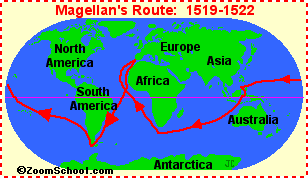 Ferdinand Magellan (1480-1521) was a Portuguese explorer who led the first expedition that sailed around the Earth (1519-1522). Magellan also named the Pacific Ocean (the name means that it is a calm, peaceful ocean).
Father Jacques Marquette (1637-1675) was a French Jesuit priest and explorer. He sailed to Quebec in 1666 and in 1671 started a Chippewa mission at Chequamegon Bay (at the western end of Lake Superior). Louis Joliet and Father Jacques Marquette (and five others) found the Mississippi River in 1673; they were the first Caucasians to see the Mississippi River. They travelled along Lake Michigan to Green Bay, canoed up the Fox River, and went downstream on the Wisconsin River to the Mississippi River. They travelled almost to the mouth of the Arkansas, and then stopped because they were warned of hostile indians and Spanish explorers. They returned via the Illinois River, then the Chicago River to Lake Michigan. Marquette died of dysentery on his way to the Kaskaskian indians, to whom he had planned on preaching.
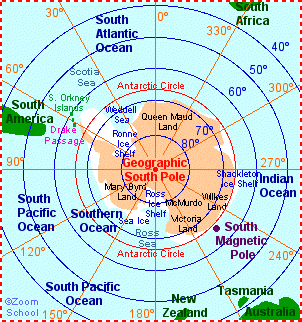 Douglas Mawson (1882 - 1958) was an Australian geologist and explorer. Mawson was a member of the British Antarctic Expedition (1907-1909) which was led by Ernest Shackleton. On a three-man sledge trip, Mawson, A.F. Mackay, and Edgeworth David traveled to the magnetic South Pole. Mawson was among the first to climb Antarctica’s Mount Erebus. Mawson also went on the scientific Australasian Antarctic Expedition (1911-1914). During this expedition, Mawson went on an ill-fated trip in which only Mawson survived, walking 100 miles (160 km) alone, hauling his geological specimens on a sled. His book “The Home of the Blizzard,” is an account of this journey. Later, Mawson led the British, Australian, New Zealand Antarctic Research Expedition (BANZARE) of 1929-31, mapping the coastline of Antarctic and discovering Mac. Robertson land and Princess Elizabeth Land (which later became the Australian Antarctic Territory). Early in his career, in 1906, Mawson identified and named the radioactive mineral Davidite (named for T. W. Edgeworth David). Mawson appears on an Australian stamp and $100 bill.
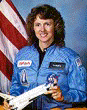
Sharon Christa Corrigan McAuliffe (1948-1986) was an American schoolteacher who was chosen to be the first teacher in space.
McAuliffe was killed, along with her six fellow astronauts (Francis R. Scobee, Michael J. Smith, Judith A. Resnik, Ellison S. Onizuka, Ronald E. McNair, and Gregory B. Jarvis), when the NASA’s Space Shuttle Challenger Mission 51-L exploded only 73 seconds after its launch on the morning of January 28, 1986.
McAuliffe was born on September 2, 1948, in Boston, Massachusetts. She taught at Concord High School in Concord, New Hampshire, before being chosen for the Space Shuttle mission (she was chosen from over 11,000 applicants). McAuliffe was married and had two children.
Peter Minuit (1580-1638) was the first director general of New Amsterdam, a Dutch colony in America. Minuit was sent to the area by the Dutch West India Company. Minuit is famous for buying the island of Manhattan (in what is now New York, USA) from Native Americans in 1626. He bought the island with trinkets valued at about $24. He founded New Amsterdam on the southern tip of Manhattan. In 1631, Minuit was dismissed from the Dutch West India Company, and in 1638 headed a Swedish group that founded New Sweden (the first European settlement on the Delaware River). Minuit bought land from the Native Americans and founded Fort Christina (near what is now Wilmington, Delaware, USA). Minuit died in a hurricane in the West Indies while on a trading mission in 1638.
Sir Thomas Livingstone Mitchell (1792- October 5, 1855) was an explorer, surveyor and author who led four surveying expeditions into southeastern Australia. Mitchell’s expeditions surveyed west of Sydney; he explored northern and western New South Wales, the Darling River system, and surrouding areas.
Mitchell was born in Craigend, Scotland. After serving in the British Army and surveying in Spain, he sailed to Sydney, Australia, in 1827. In Sydney, Mitchell was the deputy surveyor general (serving under John Oxley). He was knighted in 1839.

Moneynauts are monkeys that were sent into space. The first monkey in sub-orbital space was a squirrel monkey called Gordo. Gordo was launched into space on December 13, 1958, in the nose cone of the US Army rocket Jupiter AM-13. Gordo did well in the flight, but drowned in the Atlantic Ocean when the flotation device on the nose cone failed and it sank.
The next two monkeys in space, Able and Baker, were launched on May 28, 1959 (Jupiter AM-18). Able was a 7 pound (3.18 kilogram) rhesus monkey, and Baker, a 11 ounce (311.9 gram) squirrel monkey. They were both successfully retrieved after a 300 mile sub-orbital flight that took 16 minutes.
Go to a monkeynaut cloze (fill in the blanks) activity printout.

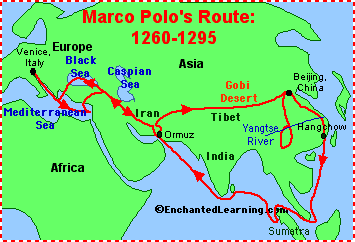 Marco Polo (1254-1324) was an Italian voyager and merchant who was one of the first Europeans to travel across Asia through China, visiting the Kublai Khan in Beijing. He left in 1271 (he was a teenager at the time) with his father (Nicolo Polo) and uncle (Maffeo Polo); they spent about 24 years traveling. [Nicolo and Maffeo had previously made a trip to China, from 1260-1269, during which the Kublai Khan (the conqueror of China) requested holy oil blessed by the Pope.]