




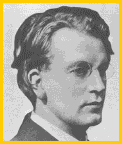
 John Logie Baird (1888-1946) was a Scottish inventor and engineer who was a pioneer in the development of mechanical television. In 1924, Baird televised objects in outline. In 1925, he televised human faces. In 1926, Baird was the first person to televise pictures of objects in motion. In 1930, Baird made the first public broadcast of a TV show, from his studio to the London Coliseum Cinema; the screen consisted of a 6-ft by 3-ft array of 2,100 tiny flashlamp bulbs. Baird developed a color television in 1928, and a stereo television in 1946. Baird’s mechanical television was usurped by electronic television, which he also worked on.
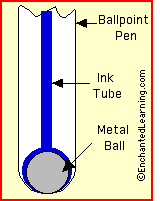
The first non-leaking ballpoint pen was invented in 1935 by the Hungarian brothers Lazlo and Georg Biro. Lazlo was a chemist and Georg was a newspaper editor.
A ballpoint marker had been invented much earlier (in 1888 by John Loud, an American leather tanner, who used the device for marking leather) but Loud’s marker leaked, making it impractical for everyday use. A new type of ink had to be developed; this is what the Biro brothers did. The brothers patented their invention and then opened the first ballpoint manufacturing plant in Argentina, South America.

Alexander Graham Bell (March 3, 1847, Edinburgh, Scotland - August 2, 1922, Baddek, Nova Scotia) invented the telephone (with Thomas Watson) in 1876. Bell also improved Thomas Edison’s phonograph. Bell invented the multiple telegraph (1875), the hydroairplane, the photo-sensitive selenium cell (the photophone, a wireless phone, developed with Sumner Tainter), and new techniques for teaching the deaf to speak. In 1882, Bell and his father-in-law, Gardiner Hubbard, bought and re-organized the journal “Science.” Bell, Hubbard and others founded the National Geographic Society in 1888; Bell was the President of the National Geographic Society from 1898 to 1903.

Tim Berners-Lee (1955, London, England - ) invented the World Wide Web. His first version of the Web was a program named “Enquire,” short for “Enquire Within Upon Everything”. At the time, Berners-Lee was working at CERN, the European Particle Physics Laboratory located in Geneva, Switzerland. He invented the system as a way of sharing scientific data (and other information) around the world, using the Internet, a world-wide network of computers, and hypertext documents. He wrote the language HTML (HyperText Mark-up Language), the basic language for the Web, and devised URL’s (universal resource locators) to designate the location of each web page. HTTP (HyperText Transfer Protocol) was his set of rules for linking to pages on the Web. After he wrote the first browser in 1990, the World Wide Web was up and going. Its growth was (and still is) phenomenal, and has changed the world, making information more accessible than ever before in history. Berners-Lee is now a Principal Research Scientist at the Laboratory for Computer Science at the MIT (Massachusetts Institute of Technology, in Cambridge, Massachusett, USA) and the Director of the W3 Consortium.

Braille is a coded system of raised dots that are used by the blind to read. Louis Braille (1809-1852) invented this system in 1829. Braille published “The Method of Writing Words, Music, and Plain Song by Means of Dots, for Use by the Blind and Arranged by Them,” and his method is still in use around the world today.
Louis Braille (Jan. 4, 1809-Jan. 6, 1852) improved a coded system of raised dots used by the blind to read. He was blinded as a child, and invented his extraordinary system in his early teens. In 1829, Braille published “The Method of Writing Words, Music, and Plain Song by Means of Dots, for Use by the Blind and Arranged by Them.” His method, called Braille, is still in use around the world today. Louis Braille is buried in the Pantheon in Paris, as a French national hero. For a worksheet on Braille, click here.
The Hall Braille typewriter (also called a Braillewriter or Brailler) was invented in 1892 by Frank Haven Hall. Hall was the Superintendent of the Illinois Institution for the Blind. The Hall Braille typewriter was manufactured by the Harrison & Seifried company in Chicago, Illinois, USA. Hall introduced his invention on May 27, 1892, at Jacksonville, Illinois. It types raised Braille dots onto paper.
Chester Floyd Carlson (1906-1968) invented xerography (which means “dry writing” in Greek) in 1938. Xerography makes paper copies without using ink (hence its name). In this process, static electricity charges a lighted plate; a plastic powder (called toner) is applied to the areas of the page to remain white.
Chester F. Carlson was born in Seattle, Washington, USA. As a teenager, Carlson supported his invalid parents by publishing a chemical journal. After attending Cal Tech in physics, Carlson worked at an electronics firm. Carlson later experimented at home to find an efficient way of copying pages. He succeeded in 1938, and marketed his revolutionary device to about 20 companies before he could interest any. The Haloid Company (later called the Xerox Corporation) marketed it, and photocopying eventually became common and inexpensive.

William Caxton (1422?-1491) was an English businessman, royal advisor, translator, editor, and printer who set up England’s first printing press in 1476. Caxton had learned about printing in Cologne, Germany. In Brussels, he printed “The Recuyell,” the first book printed in the English language, around 1474. His second publication was “The Game and Play of Chess Moralised” (printed in 1476); this was the first printed book on chess and the first printed book to use woodcut illustrations. Caxton then returned to England and set up England’s first printing press (in 1476), where he printed ” Troilus and Creseide,” ” Morte d’Arthur,” ” The History of Reynart the Foxe,” Chaucer’s ” The Canterbury Tales,” and many other books. Since Caxton refused to print regional variations in English, he began the standardization of the English language and its spelling.

The first automatic analog cellular phone was made in the 1960’s. Commercial models were introduced in Japan by NTT on December 3, 1979. They were introduced in Scandinavia in 1981, in Chicago, USA, on October 13, 1983 (by Motorola), and in Europe in the late 1980’s. Early mobile FM (frequency modulation radio was invented by Edwin H. Armstrong in 1935) radio telephones had been in use in the USA since 1946, but since the number of radio frequencies are very limited in any area, the number of phone calls was also very limited. Only a dozen or two calls could be made at the same time in an area. To solve this problem, there could be many small areas (called cells) which share the same frequencies. But when users moved from one area to another while calling, the call would have to be switched over automatically without losing the call. In this system, a small number of radio frequencies could accommodate a huge number of calls. This cellular phone concept was devised by a team of researchers at Bell Labs in 1947, but there were no computers available to do the switching. As small inexpensive computers were developed, cell phones could be produced. Motorola holds the US patents for the cell phone. Henry Taylor Sampson and George H. Miley hold a 1968 patent (US patent #3,591,860) on a “gamma electric cell,” which is not a component of cellular phones.
The street letter drop mailbox with a hinged door that closed to protect the mail was invented by Philip B. Downing. Downing, an African-American inventor, patented his new device on October 27, 1891 (US Patent # 462,093).

George Eastman (1854-1932) was an American inventor who made many improvements in photography. Eastman invented the dry plate method in 1879; this was an improvement in the wet plate process photographic process). He founded the Eastman Dry Plate company in 1881, located in Rochester, New York. Eastman and William Walker invented flexible roll film in 1882, eliminating the necessity of using cumbersome glass plates for photography. Eastman produced the first simple, all-purpose, fixed-focus camera in 1888, which sold for $25.00; this was the first KODAK Camera . By 1900, Eastman Kodak was producing a camera that cost only one dollar. Early cameras took round pictures. To get the film developed, the photographer had to send the entire camera to the Rochester factory. The company name was changed to Eastman Kodak Company in 1892, and is still one of the largest photographic companies in the world.
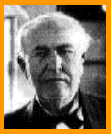
 Thomas Alva Edison (1847-1931) was an American inventor (also known as the Wizard of Menlo Park) whose many inventions revolutionized the world. His work includes improving the incandescent electric light bulb and inventing the phonograph, the phonograph record, the carbon telephone transmitter, and the motion-picture projector.
Edison’s first job was as a telegraph operator, and in the course of his duties, he redesigned the stock-ticker machine. The Edison Universal Stock Printer gave him the capital ($40,000) to set up a laboratory in Menlo Park, New Jersey, to invent full-time (with many employees).
Edison experimented with thousands of different light bulb filaments to find just the right materials to glow well, be long-lasting, and be inexpensive. In 1879, Edison discovered that a carbon filament in an oxygen-free bulb glowed but did not burn up for quite a while. This incandescent bulb revolutionized the world.
For more information on Edison, click here.

Philo Taylor Farnsworth (1906-1971) was an American inventor. Farnsworth invented many important components of the television, including power, focusing systems, synchronizing the signal, contrast, controls, and scanning. He also invented a radar system, a cold cathode ray tube, a new type of baby incubator, and the first electronic microscope. Farnsworth held over 300 patents.

Lewis E. Waterman was an American inventor and insurance salesman who developed a relatively leak-proof fountain pen; he patented his new invention in 1884 and revolutionized writing. Before his fountain pen, pen tips had to be tipped into ink after every few words. Waterman put an ink reservoir in the pen above the pen’s metal nib (point). This reservoir would hold enough ink for a few pages of writing. There were many problems in developing the fountain pen, especially the difficulty of controlling the flow of the ink. Putting a sealed reservoir above the nib wouldn’t let the ink flow, but if it wasn’t sealed, all the ink would flow at once. Waterman used capillary action to replace the ink in the rubber sac with air so that the ink flowed smoothly but did not flow all at once. Also, the metals in the ink dissolved the steel pen nib, so Waterman used an iridium-plated gold nib. Waterman was also the first person to place a clip on the cap of the pen.
Johannes Gutenberg (the 1300’s-1468) was a German craftsman, inventor, and printer who invented the first printing press with movable type in 1450. This invention revolutionized printing, making it simpler and more affordable. Gutenberg produced dies (molds) for easily producing individual pieces of metal type that could be made, assembled, and later reused. Gutenberg’s new press could print a page every three minutes. This made printed material available to the masses for the first time in history. Religious materials were the majority of the early printed materials. The use of printing presses began the standardization of spelling.

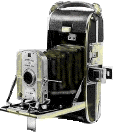 Edwin Herbert Land (1909-1991) was an American physicist and inventor who developed the first modern light polarizers (which eliminate glare) and other optical devices, investigated the mechanisms of color perception, and developed the instant photography process (the Polaroid camera). Land established the Polaroid Corp. in 1937.
Liquid Paper is a quick-drying, paper-colored (white) liquid that is painted onto paper to correct printed material. Liquid Paper was invented in 1951 by Bessie Nesmith (1922-1980). It was based on white tempera paint (Nesmith was also an artist). Nesmith was a secretary in Texas, USA, before the time of word processors. She began selling her vastly popular invention, and soon ran the very successful Liquid Paper company. Her son, Michael Nesmith, was a member of the rock group called the Monkees.

The street letter drop mailbox with a hinged door that closed to protect the mail was invented by Philip B. Downing. Downing, an African-American inventor, patented his new device on October 27, 1891 (US Patent # 462,093).

Guglielmo Marconi (1874-1937) was an Italian inventor and physicist. In 1895, Marconi promoted and popularized the radio (wireless telegraphy), building machinery to transmit and receive radio waves. His first transmission across an ocean (the Atlantic Ocean) was on December 12, 1901. Marconi won the Nobel Prize for physics in 1909.
The mechanical pencil was invented in 1915 by Tokuji Hayakawa (November 3, 1894-June 24, 1980). His first mechanical pencil was called the “Ever-Ready Sharp Pencil.” Hayakawa had owned a metalworking shop in Tokyo, Japan, and in 1942, expanded his company and renamed it the Hayakawa Electric Industry Co.,Ltd. It was later called the Sharp Corporation (1970), and Hayakawa was appointed chairman.
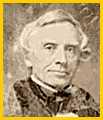
Samuel Finley Breese Morse (1791-1872) was an American inventor and painter. After a successful career painting in oils (first painting historical scenes and then portraits), Morse built the first American telegraph around 1835 (the telegraph was also being developed independently in Europe).
A telegraph sends electrical signals over a long distance, through wires. In 1830, Joseph Henry (1797-1878) made the first long-distance telegraphic device - he sent an electric current for over a mile on wire that activated an electromagnet, causing a bell to ring.
Morse patented a working telegraph machine in 1837, with help from his business partners Leonard Gale and Alfred Vail. Morse used a dots-and-spaces code for the letters of the alphabet and the numbers (Morse Code was later improved to use dots, dashes and spaces: for example E is dot, T is dash, A is dot-dash, N is dash-dot, O is dash-dash-dash, I is dot-dot, S is dot-dot-dot, etc.). By 1838, Morse could send 10 words per minute. Congress provided funds for building a telegraph line between Washington D.C. and Baltimore, Maryland, in 1843. Morse sent the first telegraphic message (from Washington D.C. to Baltimore) on May 24, 1844; the message was: “What hath God wrought?” The telegraph revolutionized long-distance communications.

Paper is writing material made from wood pulp or other fibrous material.
Almost 5,000 years ago, in ancient Egypt, the papyrus plant was processed and used as paper. Papyrus paper was made from thin sheets of papyrus pith that were soaked in water, pressed together with the grains at right angles, and then dried - the sticky sap of the plant made the thin sheets stick together, forming a sturdy writing surface. Papyrus (Cyperus papyrus is its genus and species) is a grass-like aquatic plant native to the Nile valley of Egypt. Our word paper comes from “papyrus.”
Paper is made by grinding plant material into a pulp, forming it into thin sheets, and drying it in a form. This process was invented in AD 105 by Ts’ai Lun, a Chinese official and member of the Chinese Imperial Court, about 2000 years ago; he originally used the waste from silk production. Early Chinese paper was made from the bark of the mulberry tree and other plant fibers.

The paper clip was invented in 1899 or 1890 by a Norwegian patent clerk called Johann Vaaler. His original paper clip was a thin spring-steel wire with triangular or square ends and two “tongues.” Vaaler patented his invention in Germany and later in the USA (1901).
The modern-shaped paper clip was patented in April 27, 1899 by William Middlebrook of Waterbury, Connecticut, USA.

The “lead” pencil (which contains no lead) was invented in 1564 when a huge graphite (black carbon) mine was discovered in England. The pure graphite was sawn into sheets and then cut into square rods. The graphite rods were inserted into hand-carved wooden holders, forming pencils. They were called lead pencils by mistake — at the time, graphite was called black lead or “plumbago,” from the Greek word for lead (it looked and acted like lead, and it was not known at the time that graphite consisted of carbon and not lead).
In 1795, Nicolas-Jacques Conté (a French officer in Napoleon’s army) patented the modern method of kiln-firing powdered graphite with clay to make pencils of any desired hardness.

Records, used to record sound, were invented in 1877 by Thomas Alva Edison, who invented the first machine to record and play back sounds (the phonograph or record player). Early records were cylindrical, but flat disks soon replaced them.
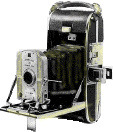
Edwin Herbert Land (1909-1991) was an American physicist and inventor who developed the first modern light polarizers (which eliminate glare) and other optical devices, investigated the mechanisms of color perception, and developed the instant photography process (the Polaroid camera). Land established the Polaroid Corp. in 1937.
The first printing press with movable type was invented in 1450 by Johannes Gutenberg. This invention revolutionized printing, making it simpler and more affordable. Gutenberg produced dies (molds) for easily producing individual pieces of metal type that could be made, assembled, and later reused. Gutenberg’s new press could print a page every three minutes. This made printed material available to the masses for the first time in history. Religious materials were the majority of the early printed materials. The use of printing presses began the standardization of spelling.
The radio was invented by Nikola Tesla. The radio was promoted and popularized by Guglielmo Marconi in 1895. The first radio transmission across an ocean (the Atlantic Ocean) occurred on December 12, 1901.
RecordRecords, used to record sound, were invented in 1877 by Thomas Alva Edison, who invented the first machine to record and play back sounds (the phonograph or record player). Early records were cylindrical, but flat disks soon replaced them.
Samuel Finley Breese Morse (1791-1872) was an American inventor and painter. After a successful career painting in oils (first painting historical scenes and then portraits), Morse built the first American telegraph around 1835 (the telegraph was also being developed independently in Europe).
A telegraph sends electrical signals over a long distance, through wires. In 1830, Joseph Henry (1797-1878) made the first long-distance telegraphic device - he sent an electric current for over a mile on wire that activated an electromagnet, causing a bell to ring.
Morse patented a working telegraph machine in 1837, with help from his business partners Leonard Gale and Alfred Vail. Morse used a dots-and-spaces code for the letters of the alphabet and the numbers (Morse Code was later improved to use dots, dashes and spaces: for example E is dot, T is dash, A is dot-dash, N is dash-dot, O is dash-dash-dash, I is dot-dot, S is dot-dot-dot, etc.). By 1838, Morse could send 10 words per minute. Congress provided funds for building a telegraph line between Washington D.C. and Baltimore, Maryland, in 1843. Morse sent the first telegraphic message (from Washington D.C. to Baltimore) on May 24, 1844; the message was: “What hath God wrought?” The telegraph revolutionized long-distance communications.

The telephone (meaning “far sound”) is the most widely used telecommunications device. It was invented in 1876 by Alexander Graham Bell (with Thomas Watson). Bell patented his invention on March 1876 (patent No. 174,465). His device transmitted speech sounds over electric wires, and his idea has remained one of the most useful inventions ever made.
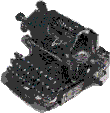
The first typewriter was invented in 1867 by the American printer and editor Christopher Latham Sholes (Feb. 14, 1819 - Feb. 17, 1890). Sholes’ prototype had the user hit a key (for each letter and number), which struck upward onto a flat plate, producing a carbon impression of the letter or number on the paper. He made the prototype using the key of an old telegraph transmitter. There was no way of spacing the letters, no carriage return, and no shift keys; these features would be added to later models.
Carlos Glidden and Samuel W. Soulé also worked in the Kleinstuber Machine Shop with Sholes, and they helped with his inventions. Their first patent was obtained on June 23, 1868. Sholes and Glidden sold the rights to their invention to the investor James Densmore, who eventually had the machine commercially manufactured. Their first commercial model was called the “Sholes & Glidden Type Writer,” and was later called the Remington typewriter. It was produced by the gunmakers E. Remington & Sons in Ilion, NY, from 1874-1878. The first author to submit a typed book manuscript was Mark Twain. Sholes’ typewriter was the beginning of a revolution in communication.
The paper clip was invented in 1899 or 1890 by a Norwegian patent clerk called Johann Vaaler. His original paper clip was a thin spring-steel wire with triangular or square ends and two “tongues.” Vaaler patented his invention in Germany and later in the USA (1901).
The modern-shaped paper clip was patented in April 27, 1899 by William Middlebrook of Waterbury, Connecticut, USA.
Lewis E. Waterman was an American inventor and insurance salesman who developed a relatively leak-proof fountain pen; he patented his new invention in 1884 and revolutionized writing. Before his fountain pen, pen tips had to be tipped into ink after every few words. Waterman put an ink reservoir in the pen above the pen’s metal nib (point). This reservoir would hold enough ink for a few pages of writing. There were many problems in developing the fountain pen, especially the difficulty of controlling the flow of the ink. Putting a sealed reservoir above the nib wouldn’t let the ink flow, but if it wasn’t sealed, all the ink would flow at once. Waterman used capillary action to replace the ink in the rubber sac with air so that the ink flowed smoothly but did not flow all at once. Also, the metals in the ink dissolved the steel pen nib, so Waterman used an iridium-plated gold nib. Waterman was also the first person to place a clip on the cap of the pen.
Liquid Paper is a quick-drying, paper-colored (white) liquid that is painted onto paper to correct printed material. Liquid Paper was invented in 1951 by Bessie Nesmith (1922-1980). It was based on white tempera paint (Nesmith was also an artist). Nesmith was a secretary in Texas, USA, before the time of word processors. She began selling her vastly popular invention, and soon ran the very successful Liquid Paper company. Her son, Michael Nesmith, was a member of the rock group called the Monkees.
Tim Berners-Lee (1955, London, England - ) invented the World Wide Web. His first version of the Web was a program named “Enquire,” short for “Enquire Within Upon Everything”. At the time, Berners-Lee was working at CERN, the European Particle Physics Laboratory located in Geneva, Switzerland. He invented the system as a way of sharing scientific data (and other information) around the world, using the Internet, a world-wide network of computers, and hypertext documents. He wrote the language HTML (HyperText Mark-up Language), the basic language for the Web, and devised URL’s (universal resource locators) to designate the location of each web page. HTTP (HyperText Transfer Protocol) was his set of rules for linking to pages on the Web. After he wrote the first browser in 1990, the World Wide Web was up and going. Its growth was (and still is) phenomenal, and has changed the world, making information more accessible than ever before in history. Berners-Lee is now a Principal Research Scientist at the Laboratory for Computer Science at the MIT (Massachusetts Institute of Technology, in Cambridge, Massachusett, USA) and the Director of the W3 Consortium.
Xerography (which means “dry writing” in Greek) is a proces of making copies that was invented in 1938 by Chester Floyd Carlson (1906-1968). Xerography makes copies without using ink (hence its name). In this process, static electricity charges a lighted plate; a plastic powder (called toner) is applied to the areas of the page to remain white. Carlson marketed his revolutionary device to about 20 companies before he could interest any. The Haloid Company (later called the Xerox Corporation) marketed it, and photocopying eventually became common and inexpensive.