




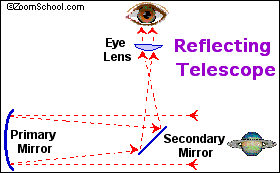
 John Hadley (1682-1744) was an English mathematician and inventor who built the first reflecting telescope and invented an improved quadrant in 1731 (known as Hadley’s quadrant). Hadley Rille, a long valley on the surface of the moon, was named for Hadley.
James Hargreaves (1720? - April 22, 1778) was an English weaver and spinner (he spun wool thread using a spinning wheel). He invented the spinning jenny, a hand-powered multiple spinning machine.
The spinning jenny was much more efficient than the spinning wheel. With a spinning wheel, a person could produce only one yarn thread at a time. With Hargreaves’ spinning jenny, a person could produce up to eight threads at once (it used one spinning wheel and 8 spindles on which threads were wound). The thread that the spinning jenny produced was coarse, and was only suited for filling material, but it was still quite a useful invention, and led the way to even better spinning devices.
Hargreaves is said to have gotten the idea for his remarkable invention after his young daughter (named Jenny) overturned his spinning wheel. When it was upturned, it continued to spin, and Hargreaves realized that many spinning wheels could be positioned like this, creating a multiple-wheeled spinning machine.
Hargreaves began selling spinning jenny’s from his home, near Blackburn, Lancashire, England. After hearing of his invention, local spinners became fearful of losing their jobs and broke into Hargreaves’ house, destroying his spinning jennies. He then moved to Nottingham, England (in 1768).
Thomas James became Hargreaves’ partner and they began a spinning mill which used spinning jennies (which could now produce even more threads per machine). Hargreaves patented the spinning jenny on July 12, 1770.
The mechanical pencil was invented in 1915 by Tokuji Hayakawa (November 3, 1894-June 24, 1980). His first mechanical pencil was called the “Ever-Ready Sharp Pencil.” Hayakawa had owned a metalworking shop in Tokyo, Japan, and in 1942, expanded his company and renamed it the Hayakawa Electric Industry Co.,Ltd. It was later called the Sharp Corporation (1970), and Hayakawa was appointed chairman.

The steam engine was invented by Heron, an ancient Greek geometer and engineer from Alexandria. Heron lived during the first century AD and is sometimes called Hero. Heron made the steam engine as a toy, and called his device “aeolipile,” which means “wind ball” in Greek. The steam was supplied by a sealed pot filled with water and placed over a fire. Two tubes came up from the pot, letting the steam flow into a spherical ball of metal. The metallic sphere had two curved outlet tubes, which vented steam. As the steam went through the series of tubes, the metal sphere rotated. The Greeks never used this remarkable device for anything but a novelty. A steam engine designed for real work wasn’t designed until 1690, when Dionysius Papin published plans for a for a high-pressure steam engine. Thomas Savery built the first steam engine in 1698. James Watt later improved the steam engine.
A geologic time scale is a diagram that details the history of the Earth’s geology, noting major events like the formation of the Earth, the first life forms and mass extinctions. The first geologic time scale was proposed in 1913 by the British geologist Arthur Holmes (1890 - 1965). Holmes was also the first person to realize that the Earth was billions of years old (not millions, as had been previously believed). For more information on geologic time scale, click here.

Rear Admiral Grace Murray Hopper (1906 - 1992) was a US naval officer and mathematician who invented the computer compiler (called the A-O) in 1952. Her compiler revolutionized computer programming, automatically translating high-level instructions (easier to understand by people) into machine code (the cryptic, native language of the central processing unit). Hopper and a team developed the first user-friendly business programming language, COBOL (COmmon Business-Oriented Language). There is an unconfirmed story that Hopper determined than an error in the early Mark II computer was caused by a moth that was trapped in it; she then coined the term “computer bug.”

A hot-air balloon is a balloon that is filled with hot air; it rises because hot air is less dense (lighter) than the rest of the air. Joseph and Jacques Etienne Montgolfier were two French bothers who made the first successful hot-air balloon. Their first balloon was launched in December, 1782, and ascended to an altitude of 985 ft (300 m). This type of hot-air balloon was called the Montgolfiére; it was made of paper and used air heated by burning wool and moist straw. The first passengers in a hot-air balloon were a rooster, a sheep, and a duck, whom the Montgolfier brothers sent up to an altitude of 1,640 ft (500 m) on September 19, 1783 (the trip lasted for 8 minutes); the animals survived the landing. This event was observed by King Louis XVI and Queen Marie Antoinette of France.

Hot dogs began as sausages sold in buns. They were first sold from carts by German immigrants on the streets of New York City in the 1860s. The bun replaced a plate and made the hot dog easier to carry and eat. Sauerkraut was provided as a relish on the hot dog.
The first dishwasher was patented in 1850 by Joel Houghton; his machine was a hand-turned wheel that splashed water on dishes - unfortunately, it wasn’t very effective at washing dishes. The first working automatic dishwasher was invented by Mrs. Josephine Garis (W. A.) Cochran, of Shelbyville, Illinois, in 1889. Her dishwasher was a wooden tub with a wire basket in it - the dishes went in the basket, and rollers rotated the dishes. As a handle on the tub was turned, hot, soapy water was sprayed into the tub, cleaning the dishes. Cochran’s machine was first shown at the 1893 World’s Fair in Chicago, Illinois. At first, her machine was only bought by some restaurants and hotels. Cochran’s small company was eventually associated with the KitchenAid company. The dishwasher didn’t become widespread as a labor-saving machine until the 1960s.

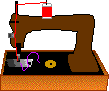 Elias Howe (1819-1867) was American inventor who patented an improved sewing machine in 1846. His revolutionary machine used two separate threads, one threaded through the needle, and one in a shuttle; it was powered by a hand crank. A sideways-moving needle with its eye at one end would pierce the fabric, creating a loop of thread on the other side; a shuttle would then push thread through the loop, creating a tight lock stitch. Earlier sewing machines used only one thread and a chain stitch that could unravel. Howe’s business did not thrive. Others, like Isaac Singer made slight modifications in the machine and built successful businesses. Howe sued those who had infringed on his patent and won royalties on all machines sold (he was paid $5.00 for each sewing machine sold). Howe died the year his patent expired.
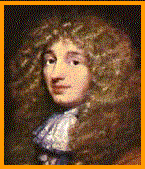
Christian Huygens (1629-1695) was a Dutch physicist and astronomer who developed new methods for grinding and polishing glass telescope lenses (about 1654). With his new, powerful telescopes, he identified Saturn’s rings and discovered Titan, the largest moon of Saturn in 1655. Huygens also invented the pendulum clock in 1656 (eliminating springs), wrote the first work on the calculus of probability (De Ratiociniis in Ludo Aleae, 1655), and proposed the wave theory of light (Traité de la lumiere, 1678).
Celluloid is a plastic made from cellulose (it is derived from plants). This very flammable material was invented in 1869 by the American inventor John Wesley Hyatt (it was invented to be a substitute for the elephant ivory used for billiard balls). Celluloid was one the first plastics invented; it can be damaged by moisture.
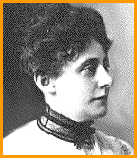
 Ida Henrietta Hyde (1857-1945) was an American physiologist who invented the microelectrode in the 1930’s. The microelectrode is a small device that electrically (or chemically) stimulates a living cell and records the electrical activity within that cell. Hyde was the first woman to graduate from the University of Heidelberg, to do research at the Harvard Medical School and to be elected to the American Physiological Society.