



 |


|


|


|


|
|


|


|


|
|
|
|
|
|
|
|
|
|
|
|
|
Introduction
 Neptune is the eighth planet from the sun in our solar system. This ice giant has a hazy atmosphere and strong winds. It is orbited by eight moons and narrow, faint rings arranged in clumps. Neptune’s blue color is caused by the methane (CH4) in its atmosphere; this molecule absorbs red light.
Neptune cannot be seen using the eyes alone. Neptune was the first planet whose existence was predicted mathematically (the planet Uranus’s orbit was perturbed by an unknown object which turned our to be another gas giant, Neptune).
Size
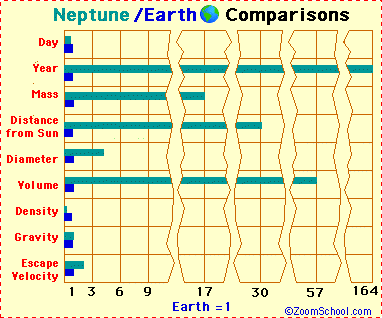
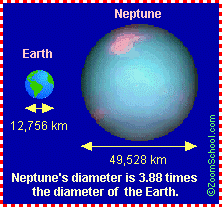 Neptune is about 30,775 miles (49,528 km) in diameter. This is 3.88 times the diameter of the Earth. If Neptune were hollow, it could hold almost 60 Earths.
Neptune is the fourth largest planet in our Solar System (after Jupiter, Saturn, and Uranus).
Mass and Gravity
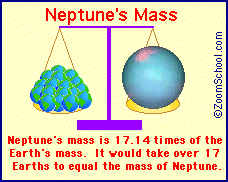 Neptune’s mass is about 1.02 x 1026 kg. This is over 17 times the mass of the Earth, but the gravity on Neptune is only 1.19 times of the gravity on Earth. This is because it is such a large planet (and the gravitational force a planet exerts upon an object at the planet’s surface is proportional to its mass and to the inverse of its radius squared).
A 100-pound person would weigh 119 pounds on Neptune.
Length of a Day and a Year
 Each day on Neptune takes 19.1 Earth hours. A year on Neptune takes 164.8 Earth years; it takes almost 165 Earth years for Neptune to orbit the sun once.
Since Neptune was discovered in 1846; since then it completed about a single revolution around the sun.
Orbital Distance from the Sun
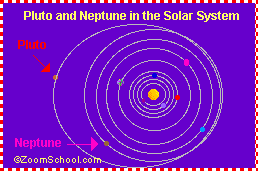
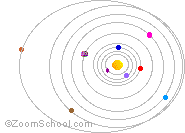 Neptune is about 30 times farther from the sun than the Earth is; it averages 30.06 A.U. from the sun. Occasionally, Neptune’s orbit is actually outside that of Pluto; this is because of Pluto’s highly eccentric (non-circular) orbit. During this time (20 years out of every 248 Earth years), Neptune is actually the farthest planet from the Sun (and not Pluto). From January 21, 1979 until February 11, 1999, Pluto was inside the orbit of Neptune. Now and until September 2226, Pluto is outside the orbit of Neptune.
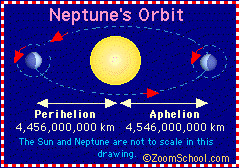
At aphelion (the point in Neptune’s orbit farthest from the sun) Neptune is 4,546,000,000 km from the sun, at perihelion (the point in Neptune’s orbit closest from the sun) Neptune is 4,456,000,000 km from the sun.
Neptune’s rotational axis is tilted 30 degrees to the plane of its orbit around the Sun (this is few degrees more than the Earth). This gives Neptune seasons. Each season lasts 40 years; the poles are in constant darkness or sunlight for 40 years at a time.
Temperature
 The mean temperature is 48 K.
Discovery
 Neptune’s existence was predicted in 1846, after calculations showed perturbations in the orbit of Uranus. The calculations were done independently by both J.C. Adams and Le Verrier. Neptune was then observed by J.G. Galle and d’Arrest on September 23, 1846.
Spacecraft Visits
Neptune was visited by NASA’s Voyager 2 in August, 1989. Before this visit, virtually nothing was known about Neptune.
Neptune-Earth Comparison
Name and Symbol

This is the symbol of the planet Neptune.
Neptune was named after the mythical Roman god of the seas. Neptune’s symbol is the fishing spear.
Links and Activities
- Neptune coloring page
- Find It!, a quiz on Neptune.
- Neptune Cloze Printout: A fill-in-the-blanks activity on the planet Neptune. Answers
- An interactive puzzle about Neptune
- How to write a report on a planet - plus a rubric.