




What is a Nebula?
 A nebula is a huge, diffuse cloud of gas and dust in intergalactic space. The gas in nebulae (the plural of nebula) is mostly hydrogen gas (H2).
Stellar Nursery
 A stellar nursery is a nebula ( a large cloud of hydrogen gas in space) in which star formation is occurring (stars are formed from gas). These nebulae are frequently illuminated by ultraviolet light which is emitted from the newborn stars. One example of a stellar nursery is the Eagle nebula pictured above.
Planetary Nebula
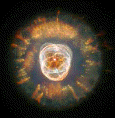
The Eskimo Nebula (NGC 2392) in Gemini
was first sighted by William Herschel in 1787.
The picture above is from the Hubble Space Telescope
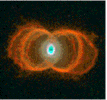
The Hourglass Nebula (NGC 6523) in M8
A planetary nebula is a nebula formed from by a shell of gas which was ejected from a certain kind of extremely hot star (a red giant or supergiant). As the giant star explodes, the core of the star is exposed. Planetary nebulae have nothing to do with planets.
Emission Nebula
 An emission nebula is a nebula that glows (it emits light energy). The reddish light is produced when electrons and protons combine, forming hydrogen atoms. Emission nebulae are formed when energetic ultraviolet light from a very hot star excites a cloud of hydrogen gas; the UV radiation ionizes the hydrogen (it strips electrons from the hydrogen atoms). The free electrons combine with protons, forming hydrogen and red light. The Horsehead Nebula is in front of an emission nebula which illuminates the outline of the “horse head.”
Reflection Nebula
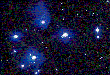 A reflection nebula is a nebula that glows as the dust in it reflects the light of nearby stars. These nebulae are frequently bluish in color because blue light is more efficiently reflected than red light. A reflection nebula surrounds the Pleiades Cluster.
Ring Nebula
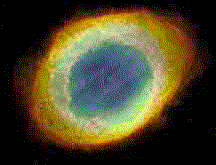 A ring nebula is a huge cloud of dust and gas that is shaped like a ring. Pictured to the right is M-57, a ring nebula in Lyra which is 2,000 light-years from Earth (this nebula was discovered by Ch. Messier).
Some Well-Known Nebulae
Crab Nebula
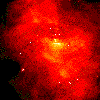 The Crab Nebula (M1) is a cloud of intergalactic gas and dust. It is the remnant of a supernova that was seen on Earth in 1054. The Crab Nebula can be found in the constellation Taurus.
Cygnus Loop
 The Cygnus loop is a nebula, a supernova remnant in the constellation Cygnus. It covers a region in the sky six times the diameter of the full Moon. The supernova exploded about 15,000-20,000 years ago and is still expanding. The nebula is almost spherical with some bright filaments.
Eagle Nebula
The Eagle Nebula (M16) consists of enormous columns of cool interstellar hydrogen gas and dust that are about 7,000 light-years from Earth (in the constellation Serpens). This star-forming cloud (a stellar nursery) is illuminated by ultraviolet light that is emitted from newborn stars. The columns are called EGG’s (Evaporating Gaseous Globules) because the ultraviolet light boils off some of the hydrogen gas (H2), shaping the nebula in a process called photoevaporation. The biggest column is about 1 light-year tall.
Horsehead Nebula
The Horsehead Nebula is a huge cloud of dust in space that is shaped like a horse’s head. It is luminous at its edges because it is in front of a bright emission nebula. It is located in the constellation Orion.
Orion Nebula
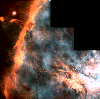 The Orion Nebula (M42 and M43) is a huge, nearby, turbulent gas cloud (mostly hydrogen) that is lit up by bright, young hot stars (including the asterism called Trapezium) that are developing within the nebula. This nebula is located about 1,500 light-years away from us towards the constellation of Orion. The Orion Nebula is roughly 30 light-years in diameter.