
|
| You might also like: | Slow Worm Printout | Earthworm Read-and-Answer Quiz | Label Earthworm Diagram | Worm Acrostic Poem | Nightingale Printout | Today's featured page: Drawing and Adding Fractions, Printable Worksheets |
| Go to a Quiz More invertebrates |
EnchantedLearning.com Earthworm |
Animal Printouts Label Me! Printouts |
 Earthworms (also called nightcrawlers) are very important animals that aerate the soil with their burrowing action and enrich the soil with their waste products (called castings). Good soil can have as many as as 1,000,000 (a million) worms per acre.
There are over 3,000 species of earthworms around the world. These invertebrates (animals without a backbone) range in color from brown to to red, and most have a soft body. Earthworms range in size from a few inches long to over 22 feet long. The largest earthworms live in South Africa and Australia.
Diet: Earthworms eat soil and the organic material in it - including plants, insect parts and bacteria.
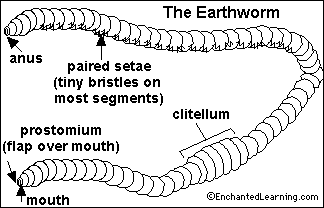
Anatomy: The earthworm is a tube-shaped worm that is covered by a moist, protective cuticle. The body earthworm's body is divided into about 150 segments. Tiny bristles (plural setae, singular seta) appear in pairs on most segments of the earthworm's body. On one end is the the mouth (which is covered by a flap, called the prostomium, that helps the earthworm sense light and vibrations). On the other end is the anus (through which waste is excreted). The brain, hearts, and breathing organs are located in the first few segments of the worm. Earthworms breathe through their skin -- they have no lungs (if the skin dries out, they cannot breathe and will die). It has five pairs of hearts. The rest of the inside of an earthworm is filled with the intestines, which digest its food. Mature worms have a clitellum (the enlarged segments in the middle of the earthworm), the reproductive parts of this worm.
Reproduction: Although each earthworm is hermaphroditic (each worm has both male and female reproductive systems), it takes two worms to mate and reproduce. The reproductive organs are located in the clitellum. After mating, the clitellum forms an egg case/cocoon which protects the developing eggs. Newly-hatched earthworms look like tiny versions of adult earthworms.
Movement: When burrowing underground, earthworms move by having cycles of muscle contractions that alternatively lengthen and shorten the body. The bristles (setae) help hold the stationary part of the worm in place as it "launches" another part forward.
Classification: Kingdom: Animalia, Phylum Annelida: the "segmented worms" (in Latin, "annellus" means small ring), Class: Clitellata (worms having a clitellum), Subclass: Oligochaeta (meaning "few bristles").
Earthworm Activities:
 Earthworm An earthworm is an invertebrate animal with a long, segmented body and no legs. |
Earthworm Read-and-Answer Quiz Read about the earthworm, then take a quiz on it. Or go to the answers. |
 Label the Earthworm Label the external anatomy of the earthworm. Or go to the answers. |
| Search the Enchanted Learning website for: |