
|
| You might also like: | Match the Flower Words to the Pictures | State Flowers | Flowers | Today's featured page: The Gingerbread Man |
 The Venus flytrap is a small carnivorous plant from North Carolina, in the southeastern United States. The flytrap has hinged, jaw-like leaves that capture and "eat" insects.
The Venus flytrap can live in very poor soils since it supplements its diet with minerals obtained from insects.
TRAPPING INSECTS
Each trap on a Venus flytrap plant has sensitive hairs that signal the plant when it is touched and cause it to close quickly. The sweet-scented leaves attract insects. When an insect alights on a trap and triggers hairs, it causes the jaw-like leaves to snap shut. It takes about 1/30 of a second for the leaves to snap shut (in full sunlight). Cloudy conditions or low temperatures slow the reaction time.
The trapped insect is then slowly dissolved by acids and digested by the plant. About a week later, all that is left of the insect is its hard chitin exoskeleton.
A pair of flytrap leaves dies after catching insects four times. If a trap is triggered but there is no insect inside, the leaves will re-open in about a day.
GROWING ONE AT HOME!
Venus flytraps thrive in a humid environment with bright light and acid soil (sphagnum moss works well). Don't fertilize a Venus flytrap; just feed it some small insects (like ants) to keep it healthy. Keep it watered (with rain water or distilled water so the pH of the soil stays acidic). Trim dead leaves to avoid disease. Allow the plant to go dormant over winter; lower the temperature (to 33-55 degrees F or 1-12 degrees C). They can withstand a light frost.
CLASSIFICATION
|
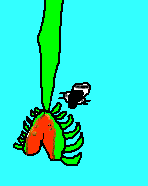 drawing by Audrey, age 6 |
Enchanted Learning®
Over 35,000 Web Pages
Sample Pages for Prospective Subscribers, or click below
|
Overview of Site What's New Enchanted Learning Home Monthly Activity Calendar Books to Print Site Index K-3 Crafts K-3 Themes Little Explorers Picture dictionary PreK/K Activities Rebus Rhymes Stories Writing Cloze Activities Essay Topics Newspaper Writing Activities Parts of Speech Fiction The Test of Time
|
Biology Animal Printouts Biology Label Printouts Biomes Birds Butterflies Dinosaurs Food Chain Human Anatomy Mammals Plants Rainforests Sharks Whales Physical Sciences: K-12 Astronomy The Earth Geology Hurricanes Landforms Oceans Tsunami Volcano |
Languages Dutch French German Italian Japanese (Romaji) Portuguese Spanish Swedish Geography/History Explorers Flags Geography Inventors US History Other Topics Art and Artists Calendars College Finder Crafts Graphic Organizers Label Me! Printouts Math Music Word Wheels |
Click to read our Privacy Policy
| Search the Enchanted Learning website for: |