

Advertisement.

EnchantedLearning.com is a user-supported site.
As a bonus, site members have access to a banner-ad-free version of the site, with print-friendly pages.
Click here to learn more.

Become a member of Enchanted Learning.
Site subscriptions last 12 months.
Click here for more information on site membership.
$20.00/year or other amount
(directly by Credit Card)
$20.00/year or other amount
(via PayPal)
$20.00/year or other amount
(for sending a check by mail)
$20.00/year or other amount
(for subscribing by school purchase order)
As a thank-you bonus, site members have access to a banner-ad-free version of the site, with print-friendly pages.
(Already a member? Click here.)

Enchanted Learning
Zoom Explorers
A B C D E F G H I J K L M N O P Q R S T U V W X Y Z
Africa Antarctica Arctic Australia Canada Mexico North America South America Space Undersea
1300's and Earlier 1400's Early 1500's Late 1500's 1600's 1700's 1800's 1900's Glossary of Exploration Terms

Ferdinand Magellan: World Explorer

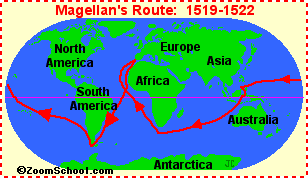
Ferdinand Magellan (1480-1521) was a Portuguese explorer who led the first expedition that sailed around the Earth (1519-1522). Magellan also named the Pacific Ocean (the name means that it is a calm, peaceful ocean).

Magellan was born in Northern Portugal (either in Sabrosa or in Oporto). His parents, Pedro Ruy de Magalhaes and Alda de Mezquita, were members of the nobility (they were wealthy and powerful).

Early in his career, Magellan sailed to India and to the Far East many times via Africa's Cape of Good Hope. He sailed for his native Portugal, but a dispute with the Portuguese King Manoel II turned him against the Portuguese. Thereafter, he sailed for Spain.

Magellan and his friend the astronomer Ruy de Falero proposed to King Charles V (of Spain) that a westward voyage around the tip of South America would take them to the Moluccas (spice-rich islands) and avoid the Portuguese (with whom they were competing fiercely). The voyage began September 8, 1519, and lasted until September 6, 1522 (almost 3 years). Magellan sailed from Seville, Spain, with five ships, the Trinidad, San Antonio, Concepcion, Victoria, and Santiago. Three years later, only one ship (the Victoria) made it back to Seville, carrying only 18 of the original 270 crew members. Magellan was killed towards the end of the voyage, on the Island of Mactan in the Philippines, during a battle with the natives. The Basque navigator Juan Sebastián de Elcano (del Cano) completed the trip.

Go to a Magellan printout.

EnchantedLearning.com
Zoom Explorers
Search EnchantedLearning.com for your explorer:
A B C D E F G H I J K L M N O P Q R S T U V W X Y Z
Africa Antarctica Arctic Australia Canada Mexico North America South America Space Undersea Women
1300's and Earlier 1400's Early 1500's Late 1500's 1600's 1700's 1800's 1900's Glossary of Exploration Terms
Guidelines for Writing a Report on an Explorer


Enchanted Learning®
Over 20,000 Web Pages.
Sample Pages for Prospective Subscribers

Overview of Site
What's New
Enchanted Learning Home
Monthly Activity Calendar
Books to Print
Site Index

K-3
Crafts
K-3 Themes
Little Explorers
Picture dictionary
PreK/K Activities
Rebus Rhymes
Stories
Writing
Cloze Activities
Essay Topics
Newspaper
Writing Activities
Parts of Speech

Fiction
The Test of Time
Biology
Animal Printouts
Biology Label Printouts
Biomes
Birds
Butterflies
Dinosaurs
Food Chain
Human Anatomy
Mammals
Plants
Rainforests
Sharks
Whales
Physical Sciences
Astronomy
The Earth
Geology
Hurricane
Landforms
Oceans
Tsunami
Volcano
Languages
Dutch
French
German
Italian
Japanese (Romaji)
Portuguese
Spanish
Swedish
Geography/History
Explorers
Flags
Geography
Inventors
US History

Other Topics
Art and Artists
Calendars
Crafts
Graphic Organizers
Label Me! Printouts
Math
Music

Click to read our Privacy Policy

E-mail


Enchanted Learning Search

First search engine with spelling correction and pictures!
Search EnchantedLearning.com for all the words:
Enter one or more words, or a short phrase.
You can use an asterisk * as a wild-card.


Advertisement.


Advertisement.


Copyright ©2002-2008 EnchantedLearning.com ------ How to cite a web page