
|
| You might also like: | K-T EXTINCTION - Paleontology and Geology Glossary | Dinosaur Tails | Dinosaur Defense | Dinosaur Skin | Dinosaur Locomotion - ZoomDinosaurs.com | Today's featured page: White House |
 |
DINOSAUR ANATOMY AND BEHAVIOR |
 |
| General Anatomy | Size | Teeth | Herds, Packs | Offense | Defense | Reproduction, Nests & Eggs | Blood Pressure |
| Skeleton | Tails | Brains | Male or Female? | Skin | Diet | Locomotion | Life Span | Hot or Cold Blooded? |
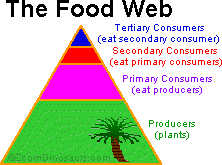 Some dinosaurs were carnivores (meat-eaters) but most were herbivores (plant-eaters). This is true for all animal populations. In any food chain, there have to be more organisms at the lower levels of the chain because the transfer of food energy is inefficient and much of the energy is lost at each stage of the process.
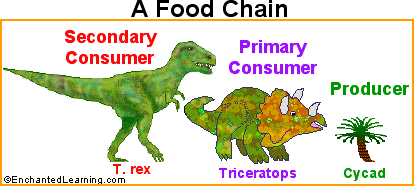
A large number of plants (called producers or autotrophs) can support a smaller number of plant-eaters (called primary consumers). These plant-eaters are eaten by a smaller number of carnivores (secondary consumers).
For example, it may have taken hundreds of acres of plants to feed a small group of Triceratops. These Triceratops could supply a single T. rex with enough food to survive over its lifetime.
If you look at dinosaur genera, roughly 65 percent of the dinosaurs were plant eaters and 35 percent were meat-eaters (or omnivores). If you look at the number of actual fossils found, the percentage of plant-eaters increases, since many fossils of some of the plant-eaters have been found. For example, over a hundred Protoceratops fossils have been found, but only about a dozen T. rex fossils have been found.
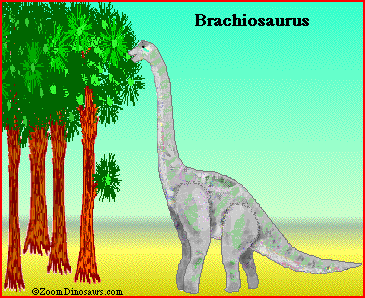 Plant-eaters (herbivores) usually have blunt teeth that are good for stripping vegetation (leaves, twigs, etc.). Some also have flat teeth for grinding tough plant fibers. Many herbivores have cheek pouches in which they can store food for a while.
Plant-eaters (herbivores) usually have to eat a much larger volume of material than meat-eaters (carnivores) do in order to get the same amount of calories (this is because leaves, twigs, and roots are low in calories). Plant-eaters usually have larger digestive systems (than meat-eaters) that are needed to digest large amounts of tough plant fibers.
Some dinosaurs swallowed  rocks (called gastroliths) to help grind up the fibers in their guts. Some (like Ankylosaurus) even had fermentation chambers, where the plant fibers were dissolved.
 |  |
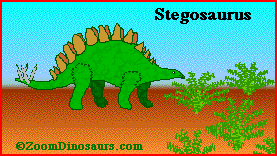 The only way to know exactly which plants a particular dinosaur ate is to find its fossilized stomach remains or coprolites (fossilized dung) containing digested plant material. Fossilized stomach remains are extremely rare, and coprolites are hard to match up to a particular dinosaur. Given these limitations, all you can do is guess a dinosaur's diet based on the type of teeth the dinosaur had (could it eat soft or tough plant material), where it lived (climate, habitat, etc., which aren't generally known), and which plants were around during that particular time period (for plants that lived during the Mesozoic, click here). For most dinosaurs, you just have to guess (given the constraints listed above) among likely plants, including ferns, cycads, horsetails, club mosses, seed ferns, conifers, and gingkos, abounded during the Mesozoic. Flowering plants evolved during the Cretaceous period.
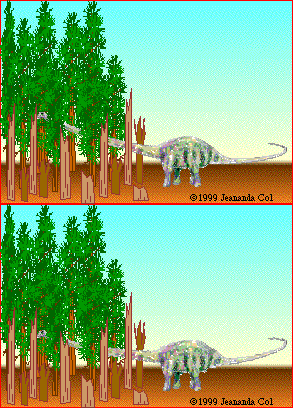 Some herbivorous dinosaurs include: Ankylosaurus, Apatosaurus, Camarasaurus, Diplodocus, Dryosaurus, Euoplocephalus, Heterodontosaurus, Hypsilophodon, Iguanodon, Kentrosaurus, Lambeosaurus, Lesothosaurus, Maiasaura, Massospondylus, Montanoceratops, Pachycephalosaurus, Parasaurolophus, Protoceratops, Riojasaurus, Sauropelta, Seismosaurus, Stegoceras, Stegosaurus, Styracosaurus, Supersaurus, Triceratops, Ultrasauros, Xiaosaurus, Zigongosaurus, and many, many others.
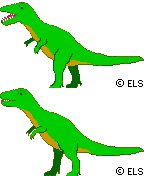 Meat-eaters (carnivores or theropods) need to have some way to get meat. Carnivorous dinosaurs usually had long, strong legs so that they could run quickly in order to catch their prey. They also needed large, strong jaws, sharp teeth, and deadly claws so they could kill and then tear apart the prey. Good eyesight, a keen sense of smell, and a large brain to plan hunting strategies are also very important for successful hunting. Many of the carnivores (like Deinonychus, Coelophysis and Velociraptor) may have hunted in packs, so social cooperation was necessary for a good hunt for some species. Animals that are primarily scavengers (animals that eat meat that they did not kill themselves) need very sharp teeth and strong jaws for tearing into less than prime cuts of meat, and breaking bones to get the nutritious bone marrow. Most carnivores are scavengers when given the opportunity. Some dinosaurs were fish eaters, including Baryonyx and Suchomimus. Spinosaurus may have been a good swimmer (it had paddle-like feet similar to those of water birds). A few dinosaurs (including Coelophysis) have been found with small, fossilized animals within their fossil, giving information about their diet. Some dinosaurs may have even been cannibals, eating their own kind.
 Only a few of the known dinosaurs were omnivores (eating both plants and animals). Some examples of omnivores are Ornithomimus and Oviraptor, which ate plants, eggs, insects, etc. Also, most herbivores are "accidental omnivores" because when they eat plants, they accidentally ingest many insects and other small animals.
|
DINOSAUR ANATOMY AND BEHAVIOR |
|
| General Anatomy | Size | Teeth | Herds, Packs | Offense | Defense | Reproduction, Nests & Eggs | Blood Pressure |
| Skeleton | Tails | Brains | Male or Female? | Skin | Diet | Locomotion | Life Span | Hot or Cold Blooded? |
Enchanted Learning®
Over 35,000 Web Pages
Sample Pages for Prospective Subscribers, or click below
|
Overview of Site What's New Enchanted Learning Home Monthly Activity Calendar Books to Print Site Index K-3 Crafts K-3 Themes Little Explorers Picture dictionary PreK/K Activities Rebus Rhymes Stories Writing Cloze Activities Essay Topics Newspaper Writing Activities Parts of Speech Fiction The Test of Time
|
Biology Animal Printouts Biology Label Printouts Biomes Birds Butterflies Dinosaurs Food Chain Human Anatomy Mammals Plants Rainforests Sharks Whales Physical Sciences: K-12 Astronomy The Earth Geology Hurricanes Landforms Oceans Tsunami Volcano |
Languages Dutch French German Italian Japanese (Romaji) Portuguese Spanish Swedish Geography/History Explorers Flags Geography Inventors US History Other Topics Art and Artists Calendars College Finder Crafts Graphic Organizers Label Me! Printouts Math Music Word Wheels |
Click to read our Privacy Policy
| Search the Enchanted Learning website for: |