Advertisement.
EnchantedLearning.com is a user-supported site.
As a bonus, site members have access to a banner-ad-free version of the site, with print-friendly pages.
Click here to learn more.
(Already a member? Click here.)
Old Questions
Questions from Jan.-Feb. 1998
Q:During what period of geologic time did the T-rex exist?
from Shina, Denver, CO, USA; Feb. 27, 1998
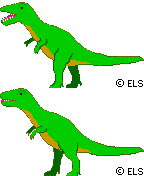 A: Tyrannosaurus rex lived during the late Cretaceous period, about 85 to 65 million years ago. Fossils have been found in the western USA (in Montana, Texas, Utah, and Wyoming), Canada (Alberta and Saskatchewan), and Asia (Mongolia).
Click here for an information sheet on T. rex.
Q: Please, send me all the facts about Gigantosaurus. Nikola
from Nikola K., Belgrade, Serbia, Yugoslavia; March 2, 1998
Q: What time period was the Giganotosaurus from?
from Colleen, Pennsville, NJ, USA; Feb. 28, 1998
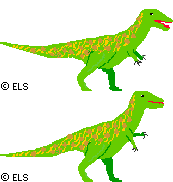 A: Giganotosaurus lived during the mid-Cretaceous period, about 100 million years ago. For more information on Giganotosaurus, click here.
Q: I am doing a project on Dromaeosaurus dinosaurs and can only seem to find info on Velociraptors. What are the differences between the two and where can I find a picture of the Dromaeosaurus?
from Josh R., Crofton, Maryland, USA; Feb. 28, 1998
A: Dromaeosaurus and Velociraptor were very similar. They were both from the family Dromaeosauridae, a family of terrifying predators from the Cretaceous period. This family was the smartest of all dinosaurs and was also speedy, large-headed, clawed, and may have hunted in packs. They had sharp teeth, a large, sickle-shaped claw on one toe, and clawed hands. The family includes Deinonychus  , Velociraptor, Dromaeosaurus, Saurornitholestes, etc.). Velociraptor and Dromaeosaurus were about the same size and both lived during the late Cretaceous.
As for differences between the two, Velociraptor had a longer, flatter snout and a slightly smaller sickle-shaped toe claw than the other Dromaeosaurids (including Dromaeosaurus). Also, Velociraptor has been found in Asia while Dromaeosaurus has been found in North America. Dromaeosaurus is only known from incomplete fossils, while many Velociraptor fossils have found.
Q: Hi! I'm Samantha and I wondered if you would answer my question. I wanted to know more about dinosaurs, so would you tell me some stuff or info on Struthiomimus?
from Samantha, Strathray, Ontario, CA; Feb. 2, 1998
A: Struthiomimus was an ostrich-like carnivorous dinosaur from the late Cretaceous period. It was about 12 feet (3.7 m) long and about 6 feet (1.8 m) tall. It had a long neck, small head with a toothless horny beak, walked on two strong legs, had long arms, three-fingered hands with curved claws, three-toed feet, large eyes, large brains, and a long tail for balancing. It must have been a very fast runner, like an ostrich. It probably laid eggs and ran in herds. Fossils have been found in North America (Alberta, Canada and New Jersey, USA). It was first discovered in 1914. It is very similar to the dinosaur Ornithomimus  (a fellow member of the family Ornithomimidae, the "bird mimics"), but Struthiomimus had longer arms, and curved claws on its fingers.
Q:We are trying to find out about the Herrerasaurus. Can you help? thank you
from ?; Feb. 27, 1998
A: Herrerasaurus (meaning "Herrera's lizard;" Herrera was a goat-herd who was a friend of the discoverer of the fossil) was a late Triassic dinosaur from about 230 million years ago. It was a very early dinosaur and a primitive prosauropod. It was a speedy carnivore about 6-8 feet (1.5-2 m) long and about 300 pounds (136 kg) in weight. It was bipedal (walked on two legs), had a short neck and a large head. Fossils have been found in Argentina, South America.
Q:How much did the ichthyosaurs weigh?
from Katie F., Erie, PA, USA; Feb. 26, 1998
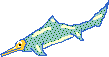 A: Ichthyosaurs were prehistoric reptiles that lived in the sea - they were not dinosaurs. They ranged in size from 7 to 30 feet long (4.5 to 9 m). Their weights varied widely also. Click here for an information sheet on Ichthyosaurs.
Q:What color are dinosaurs?
from Alan, Las Cruces, USA; Feb. 26, 1998
A: No one knows.
Q:Did Hypsilophodon travel in a herd or by itself?
from Alaina, Boone, IA, USA; Feb. 25, 1998
 A: A bonebed of about 20 Hypsilophodon fossils were unearthed together on the Isle of Wight (an island off the coast of southern England). This indicates that a herd of Hypsilophodon died together.
Q:Did Oviraptor travel in a herd, with a partner, or by itself?
from Chris, Boone, IA, USA; Feb. 26, 1998
A: I haven't heard of any evidence of Oviraptor bonebeds (large deposits of bones of the same species in an area), fossilized trackways of many dinosaurs travelling together, or large groups of fossilized nests grouped together. This means that there is no positive evidence for herding behavior for Oviraptors.
Q:What time period did Stegosaurus live in?
from Rithu S., Coralville, IA, USA; Feb. 25, 1998
 A: Stegosaurus lived during the late Jurassic period.
Q:What is the length and the weight for Anatosaurus?
from Shana B., Coralville, IA, USA; Feb. 25, 1998
A: Anatosaurus (the "duck lizard") was a late-Cretaceous hadrosaur about 30 feet (9 m) long, 14 feet (4.3 m) tall, and about 3.5 tons.
Q:What kind of hip did Oviraptor have? How did they travel?
from Chris, Boone, IA, USA; Feb. 25, 1998
A: Oviraptor was a theropod, a "Lizard-Hipped" or Saurischian dinosaur. I'm not sure what you mean by "How did they travel?"
Q:Is ankylosaur same as ankylosaurus? Could you give me some details of the size of ankylosaur.
from Ming; Feb. 24, 1998
Q:Does ankylosaur goes on groups or individuals. What type of rock would ankylosaur be formed in?
from Drills; Feb. 24, 1998
Q:WHERE DOES THE ANKYLOSAURES LIVE?
from ???; Feb. 24, 1998
 A: The ankylosaurs were a group of heavily armored, tank-like, plant-eating dinosaurs with tail clubs that included species like Ankylosaurus, Talarurus, Saichania, and Euoplocephalus. For an information sheet on Ankylosaurus, click here.
I can't find any evidence of herds of Ankylosaurus. Sedimentary rock is where most fossils form and are found. Ankylosaurus fossils have been found in the western US.
Q:What is 'Bird-Hipped'?
from John R., Pretoria, Gauteng, South Africa; Feb. 24, 1998
A:Dinosaurs are divided into two groups, the "Bird-Hipped" and the "Lizard-Hipped" dinosaurs.
- "Bird-Hipped" dinosaurs (Ornithischians) had a hip structure that is similar to that of birds. The Ornithischian dinosaurs also were vegetarians, and included two-legged, plated, armored, and horned dinosaurs. Example of "Bird-Hipped" dinosaurs include: Triceratops, Stegosaurus, the ankylosaurs, Maiasaura, Iguanodon, etc.
- "Lizard-Hipped" dinosaurs (Saurischians) had a hip structure similar to that of lizards. Oddly enough, these "Lizard-Hipped" dinosaurs were the ancestors of the birds. The Saurischians include theropods (like T. rex, Velociraptor, and Deinonychus) and the sauropodomorphas (like Apatosaurus, Brachiosaurus, and Diploducus).
Q:I'm doing a project on the Stegosaurus and there's some infomation that i'd like to know. What are the stegosaurus's social behaviours? What adaptions or special features did the stegosaurus posses which enabled it to survive in its habitat? If you could answer these questions I would be grateful. Thanx
from Steve C., Richmond Hill, CA; Feb. 23, 1998
A:Stegosaurus may have been a herding animal, since many ot the stegosaurians were.
It was a slow mover, so when a predator approached, it had to stay put and defend itself. For protection, Stegosaurus had large spikes on its tail; its triangular plates may also have been used as protection.
Q:I am doing my science project on Diplodocus and I am having trouble finding the following: where they lived according to the continental formation and do they have and adaptations & special features? thanks
from Mark, Richmond Hill, Ontario, CA; Feb. 22, 1998
and from Mark, Scarbrough, Ontario, CA; Feb. 23, 1998
 A: Many Diplodocus fossils have been found in the Rocky Mountains of western North America (in Colorado, Montana, Utah, and Wyoming). For its special features, notably its hollow, anvil-shaped vertebrae, click here for an information sheet on Diplodocus
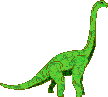 Q:Did Brachiosauruses walk with their heads up or down?
from Brittany and Bailey, Coralville, IA, USA; Feb. 22, 1998
A: Brachiosaurus most likely had a giraffe-like stance, with its head held upright.
Q:How many plates did the Stegosaurus have?
from Brady and Max, Coralville, IA, USA; Feb. 22, 1998
A: Stegosaurus had two rows of thin, triangular plates running along its back. Different specimens have different numbers of plates; I've counted 13-19 on different fossils. Neither the exact positioning of the plates nor their function is known. Also, different species of Stegosaurus had different numbers of tail spikes; Stegosaurus ungulatis had 8 spikes and Stegosaurus stenops had 4 spikes.
Q:1. What type of rock are stegosaurus fossils usually found in?
2. What adaptions or special features did the stegosaurus posses which enabled it to survive in its habitat?
3. What are the stegosaurus's social behaviours?
from ????; Feb. 22, 1998
A: Most fossils are found in sedimentary rock from the appropriate geologic age (the late Jurassic period in this case); click here to see pages on fossils.
Click here for an information sheet on Stegosaurus.
Q:I just want to know some information on Diplodocus.
I would appreciate if you can help me to answer the following
questions:
1) their habitat
2) social behaviour
3) where they lived and type of rock in which fossils are formed.
from Benson T., Aurora, Ontario, Canada; Feb. 22, 1998
A:1) Diplodocus, a large late-Jurassic sauropod, was an herbivore, eating Cycads and other plant material. During the Jurassic, the Earth had a very warm, humid climate. Diplodocus must have lived in an area rich in plant life in order to sustain its bulk.
2) I can't find information on Diplodocus social behavior, but a lot of sauropods travelled in herds (as evidenced by fossilized trackways), and hatched from eggs.
3) Fossils usually form in sedimentary rock; click here to see pages on fossils.
Click here for an information page on Diplodocus
Q:Is there any evidence to support the claim that dinosauria characteristics involved living in herds?
from Jonathan W., Melbourne, Victoria, Australia; Feb. 21, 1998
A: Some species apparently lived in herds, as revealed by fossil evidence. Evidence includes: many fossils found together in bonebeds (large deposits of bones of the same species in an area), fossilized trackways of many dinosaurs travelling together, or large groups of fossilized nests grouped together.
Q:What were the first dinosaurs?
from ???? Feb. 21, 1998
A: The earliest dinosaurs evolved during the mid-Triassic period, about 230 million years ago. The earliest dinosaurs found so far include Herrerasaurus, Eoraptor, Staurikosaurus, and Lesothosaurus.
Q:Hi. I'm a Seventh Grader and I'm doing a report on the quetzacoatlus. How did it go extinct?
from Jared, Encino, CA, USA; Feb. 21, 1998
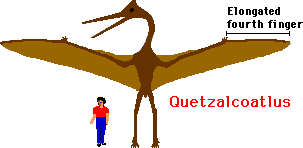 A: Quetzalcoatlus (a flying reptile, not a dinosaurs) lived during the late Cretaceous period and died out about 65 million years ago, during the K-T mass extinction. Click here for an information page on Quetzalcoatlus.
Q: Hi , I'm in second grade and I'm doing a project on the Leptoceratops. I can't find any information and I need to know when it lived, how big it was, what it ate, how it looked, how it protected itself, anything that makes my dinosaur special, and what the name means.
from MFJ, MA, USA; Feb. 21, 1998
A: Leptoceratops means "slim-horned face." It was a primitive ceratopsian, the family of large, frilled, herding dinosaurs (other ceratopsians include Psittacosaurus, Pachyrhinosaurus,
Montanoceratops, Chasmosaurus, Centrosaurus, Triceratops, Styracosaurus,
and Protoceratops). It lived during the late Cretaceous period and fossils have been found in Alberta, Canada. It was about 6-9 feet long and 2.5 feet tall. It had a short bony frill protruding from its large
skull and a parrot-like beak. It could walk on two or four legs; it's
front legs were much shorter than its hind legs. It probably ran on
four legs and grazed on two. It was a plant eater (an herbivore).
Q:Did the Maiasaura walk on two legs or four legs?
from Dani and Kimberly, Coralville, IA, USA; Feb. 20, 1998
 A: Maiasauras (click here for more information) walked on four legs. Maiasaura's front legs were much shorter than the rear legs. When they ran, they probably used only their back legs, using the tail for balance.
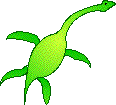 Q:What is the Plesiosaurs' weight?
from Bosung and Adam, Coralville, IA, USA; Feb. 20, 1998
A: Plesiosaurs (click here for more information) were marine reptiles (and not dinosaurs) that ranged in size from 8-43 feet long (2.5-13 m). Their weights varied proportionately.
Q:How big are a T-Rex's feet?
from Bobby M., Mechanicsville, Virginia, USA; Feb. 19, 1998
A: T-Rex's feet were massive, about 2-4 feet (0.6-1 m) long. Its toes had claws that were up to 8 inches (20 cm) long.
Q:How do Dinosaurs Reproduce?
from Mark D., Britton, South Dakota, USA; Feb. 19, 1998
A: Dinosaurs probably reproduced in ways similar to that of modern-day reptiles; for any particular dinosaur body type, find a similar existing reptile type.
Q:Were there different types of Triceratops?
from Tiffany M. R., Indianapolis, Indiana, USA; Feb. 2, 1998
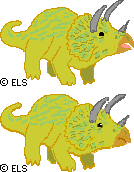 A: There is some disagreement about this. Some paleontologists (notably Ostrom and Welnhoffer, 1990) believe there is one species, Triceratops horridus. Others believe that there are two (C. Forster, 1996) or more species, including: Triceratops horridus, Triceratops prorsus, Triceratops albertensis, Triceratops ingens, Triceratops alticornis, and perhaps others.
Q:If most of the dinosaurs were related to birds, what about the other little bit of the dinosaurs. Were they related to reptiles?
from Brandon C., Canyon, Texas, USA; Feb. 18, 1998
A: Dinosaurs were reptiles. A lot of paleontologists think that birds probably evolved from the dinosaurs. You might want to read the section on dinosaurs and birds in Zoom Dinosaurs; just click on Dino-Birds in the margin to your left.
Q:I am in second grade and I am doing a dinosaur project on the Brachiosaurus. I was wondering if you could tell me where the Brachiosaurus laid its eggs and if the Brachiosaurus cared for its young.
from Jillian R., Stoneham, MA, USA; Feb. 18, 1998
A: Eggs that definitely belonged to Brachiosaurus haven't been found, but it is assumed that the sauropods layed eggs (the paleontologist Bakker disagrees and argues that sauropods gave birth to live young). Where Brachiosaurus layed its eggs or if it cared for young are unknown. Sauropod trackways (fossilized sets of tracks) have been found, indicating that the young sauropods travelled toward the center of herds, probably for protection. Whether this is true for Brachiosaurus is not known.
Q:How many different kind of dinosaurs were there?
from Damon S. R.-B., Indianapolis, Indiana, USA; Feb. 18, 1998
A: There are about 330 described dinosaur genera, and many time that number of genera that probably existed but we haven't found yet - probably thousands. There are many times that number of dinosaur species that existed, only about 600-700 have been named, but some of these are doubtful (they may be juveniles of other species, examples of a different gender, or very large or small specimens of a known species).
Q:Did all Sauropods travel in a herd? If not, which ones didn't?
from Courtney, Cassie, and Ashley, Boone, IA, USA; Feb. 18, 1998
A: Sauropods probably travelled in herds, as evidence from multiple trackways (fossilized footprints) suggests. The trackways indicate that the young sauropods travelled toward the center of the herd for protection.
Q:I need some information on Polacanthus. How tall was it. Did it travel in a herd or by itself?
from Daniel, Boone, IA, USA; Feb. 18, 1998
A: Polacanthus, a primitive ankylusaur with spines, was about 15 feet (4.6 m) long. The only was we can surmise herding behavior in an extinct species is when bonebeds (large deposits of fossil bones found together, mostly of the same species) or multiple trackways (fossilized animal tracks) are found. For Polacanthus, neither bonebeds nor multiple trackways that can be definitely attributed to Polacanthus have been found, so it is unknown whether or not it traveled in herds.
Q:I need to know if Styracosaurus traveled in a herd? Also how tall was it?
from Matt, Boone, IA, USA; Feb. 18, 1998
A: Styracosaurus was about 6 feet (1.8 m) tall and 18 feet (5.5 m) long. A bonebed of about 100 Styracosaurus fossils was found in Arizona, indicating that they did travel in herds.
Q:How does an dinosaur tear its prey with short little arms?
from John K., warwick, new york, USA; Feb. 17, 1998
A: The short armed dinosaurs, like T. rex, probably did the most damage with their huge, sharp, strong teeth set in extremely powerful and large jaws.
Q:I am doing a very large report on the dinosaur Camptosaur I need to know what kind of area that they lived in like the desert or a forest I as need to know how tall they get, What colors they are and what is their scientific name.
from L.P., Duluth, MN, USA; Feb. 17, 1998
A: There were many species of Camptosaurus (which means "bent lizard"). They lived in what is now North America and Europe during the Jurassic, a time of warm, tropical weather. It grew to be about 21 feet (6.5 m) long. No one knows what colors any of the dinosuars were. Dinosaurs' scientific names are the same as their common names.
Q:I need some information about Dilophosaurus. How tall was he? Did he have any enemies? What other meat eaters were living in the early Jurassic period?
from Daniel, Boone, IA, USA; Feb. 17, 1998
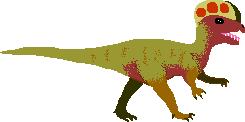 A: Dilophosaurus (meaning "two-crested lizard") was a speedy bipedal (walked on two legs) meat-eater from the late Triassic and early Jurassic periods. It was a theropod about 20 feet (6 m) long. It had short arms with three-fingered hands and strong legs with four-toed feet (one toe was a dew-claw). Both fingers and toes had claws. Fossils have been founds in Arizona, USA. Among its contemporaries in North America during the late Triassic and early Jurassic, all smaller than Dilophosaurus, were:
- the meat-eaters: Coelophysis(about 10 feet long), Syntarsus, and Segisaurus
- the omnivores: Massopondylus, and Anchisaurus
- the plant-eaters: Scutellosaurus, and Ammosaurus.
Although all of Dilophosaurus' contemporary carnivores were smaller than it, a pack of Coelophysis may have been able to kill a Dilophosaurus.
Q:I was wondering how much Fabrosaurus weighed, how tall and long he was, and how he traveled (herd, pack, partner, alone).
from Taylor, Boone, IA, USA; Feb. 16, 1998
A: Fabrosaurus is only known from an incomplete lower jaw found in South Africa. It was a very early Ornithischian dinosaur from the late Triassic period. It was lightly built dinosaur, like most early species. It was probably about 3 feet tall (90 cm) with a small head, a beak-like jaw with teeth, long feet, and short arms. It was an herbivore (plant-eater). It was bipedal (walked on two legs), but may have grazed on all fours. It probably resembled the more well-known Lesothosaur, another early Ornithischian - this is how much of Fabrosaurus' description is surmised. Not much else is known about Fabrosaurus. Fabrosaurus means "Fabre's lizard," named after Jean Henri Fabri, a French entomologist.
Q:My student, Ethan, needs some information about the dinosaur called Hoplitosaurus. He would appreciate any facts on this dinosaur so he can complete his report.
Thank you, G. Bourn, PMA
from G. Bourne, Laconia, NH, USA; Feb. 16, 1998
A: Hoplitosaurus (meaning "Hoplite lizard;" a hoplite was an armed soldier) was an ankylosaur, an armored dinosaur. It had rows of flattened horny plates running along its back. Hoplitosaurus was an herbivore (a plant-eater) that walked on four legs and lived during the early Cretaceous period. An incomplete fossil was found in South Dakota, USA.
Q:Did Velociraptor mean "Speedy Plunder","Speedy Predator", or " Speedy Thief?
Was Velociraptor 6 Feet tall?
from Ryan P., Milford, NJ, USA; Feb. 16, 1998
A:Raptor, according the to Random House unabridged dictionary, comes from a Latin word that means, "one who seizes by force, or a robber." Velociraptor was about 6 feet long (2 m), and 3 feet tall (1 m).
Q:Where there ever such things as Sabrecats?
from Andrew C., Sudbury, Ontario, CA; Feb. 15, 1998
A: Sabre-toothed cats are extinct carnivorous mammals. The were large, ferocious cats with huge fangs.
Smilodon, the sabre-toothed "tiger" from the late Pleistocene Epoch lived in packs, was up to 10 feet=3 m long, and had fangs up to 6 inches=15 cm long. It went extinct about 10,000 years ago.
Hoplophoneus is an earlier and smaller saber-toothed cat, from the Oligocene (20 million years earlier than Smilodon).
Q:Was Velociraptor as deadly as Deinonychus?
Could a pack of Velociraptors kill a Tyrannosaurus rex?
Did Velociraptor run 60mph?
from Ryan P., Milford, NJ, USA; Feb. 15, 1998
A: Deinonychus was bigger and had larger claws, so it probably was deadlier. A pack of Velociraptors could probably inflict enough wounds on a T. rex to make it bleed to death. Velociraptors were very fast runners, and could probably run about as fast as ostriches, who can run about 40-45 mph.
Q:My Second Grade class is presently working on Dinosaur Reports.We were unable to find sufficient information on the Trachodon, the Ultrasaurus,and the Seismosaurus. Could you give us some information particularly about their appearance,defence mechanisms and any other information pertaining specifically to these dinosaurs.
from Sunita S., Warsaw, Poland; Feb. 13, 1998
A: Trachodon (meaning "rough tooth") was named based on one tooth that was found in Montana, USA. It is now considered to be the same as Anatosaurus (meaning "duck lizard"), a duck-billed dinosaur (hadrosaur) from the late Cretaceous period. Anatosaurus was an herbivore with a flat head, ran on two legs, had webbed hands, and had up to 1,000 teeth in a horny bill. It was about 15 feet (4.4 m) tall, 30 feet (9 m) long, and weighed about 3.5 tons. Many fossils have been found in England and the USA.
Ultrasaurus (meaning "huge lizard") was a huge, late Jurassic Sauropod,100 feet long (30 m), and weighed over 80 tons, and perhaps up to 130 tons. It was a quadrupedal herbivore. It is known from an incomplete fossil found in the US.
Seismosaurus (meaning "Earth-shaking lizard") was another huge, late Jurassic Sauropod, about 120+ feet long (37 m), 18 feet tall (5.5 m), weighing over 80 tons. It was a quadrupedal herbivore, and may be the longest dinosaur.
Q:One of my students is researching Acanthopholis. We are having some difficultly finding information. If you have any information we would appreciate it. She is in Primary Multi-age (1-2).
Thank You!
G. Bourn, teacher
from g. b., laconia, nh, USA; Feb. 13, 1998
A: Acanthopholis (meaning "spiny scales") was an armored, quadrupedal (walked on four legs), plant-eating dinosaur from the early Cretaceous period. Its armor was rows of oval plates set into its skin, plus it had spikes jutting out of its neck and shoulder area along the spine. It was about 18 feet long (6 m). Partial fossils have been found in England.
Acanthopholis is an Ornithischian dinosaur (bird-hipped), an Ankylosaur (heavily-armored plant-eaters), and a Nodisaurid (primitive, smaller ankylosaurs with club-less tails).
Q:When was the first Dinosaur born, and when died the last? Why did they die?
from Tim S., Berlin, Germany; Feb. 13, 1998
A: The first dinosaurs evolved during the mid Triassic period, about 230 million years ago; Herrerasaurus is the earliest known dinosaur. It was a bipedal meat-eater, 10 to 20 feet long, weighed about 400 pounds, and hunted in groups.
The dinosaurs died out during the K-T extinction, 65 million years ago. The most widely accepted theory is that an asteroid or meteor hit the Earth (just off the Yucatan peninsula in Mexico), causing huge tidal waves, increasing volcanic activity, and cooling the Earth's temperature. These changes killed a lot of plant and marine species, the dinosaurs, and many animals species in a mass extinction.
Q:How tall was Parasaurolophus?
from Stacey, Boone, IA, USA; Feb. 12, 1998
A: Parasaurolophus was about 16 feet tall.
Q:My son is researching information on the Velociraptor and we are finding conflicting information on the WEIGHT,HEIGHT,and LENGTH.
Could you please help!!!! Info needed by Thursday night Feb 12th.
We thought this would be easy.. One source said weight was 30lbs and another said 213lbs. Which is it closer to?? Height varies from 2.6ft to 6ft. Length varies from 6-8ft.. Can you give us more accurate information along with your resource?
from dave f., Bel Air, MD, USA; Feb. 11, 1998
A: Getting exact average statistics on dinosaurs is difficult and often misleading. For species in which there have been hundreds of fossils found (like Protoceratops), paleontologists can determine which form of the fossil is an adult, and then calculate the average adult size. For rarer species (like Velociraptor), an average size is inaccurate at best. For even rarer species which have only one incomplete fossil, these size figures may be very misleading, or even wrong.
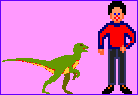 Given this caveat, Velociraptor was probably about 6 feet long and 3 feet tall (this is verified in every text I looked at today, including Dr. M. Burton's "Dinosaur Fact Finder"). As to its weight, I can't find any reliable reference. 30 pounds seems too light for an animal of that size, but 200 pounds seems too heavy. Think of your last big Thanksgiving turkey, add in the blood, guts, and other missing parts. This gets you to well over 30 pounds, and Velociraptor was a bit bigger than a turkey, had a much larger skull, and huge claws (which must have been quite heavy).
Q:Please send me information about Camptosaurus. Thanks
from Alex, Sugar Land, TX, USA; Feb. 11, 1998
A: Camptosaurus (meaning "flexible or bent lizard") was a large, bipedal, Jurassic herbivore (plant-eater) with hundreds of teeth and a horny beak. Hooves on its fingers (it had five fingers on each hand, each with a hoof) indicate that it probably walked on all fours some of the time, probably when grazing. Its legs were much longer than its arms.
There are a lot of species of Camptosaurus, ranging from the size of a turkey to about 20 feet long and 7 feet tall. Fossils have been found in Europe and North America. Camptosaurus was an ornithopod ( a bipedal, herbivorous ornithischian dinosaur).
Q:Will you give me some info about the apatosaurus and barosaurus.
from daniel, powder springs, GA, USA; Feb. 11, 1998
Q:Fossils of the same species were found on several different continents why ?
from ???; Feb. 11, 1998
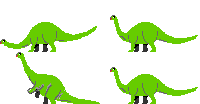 A: Click here for an information page on Apatosaurus. Barosaurus (meaning "heavy lizard") was another huge, long-necked, Jurassic sauropod. It was about 90 feet long (27 m). Its neck was about 30 feet long (9 m)!
Barosaurus fossils have been found in North America and in Africa. During the Jurassic period, the Earth's land masses were joined connected into the supercontinent Pangaea  , allowing Barosaurus (and other species) to travel by land between what is now Africa and North America.
Q:Are there any close relatives of Stegosaurus that have no large plates or spikes on there body.
from Brittany H., Dover, NH, USA; Feb. 10, 1998
A: All the Stegosaurids (like Stegosaurus, Tuojiangosaurus, Wuerhosaurus, Kentrosaurus, etc.) had two rows of plates and/or spines along their backs. That's one of the defining characteristics of the stegosaurids.
Q:How did Spinosaurus travel? Did it travel alone, with a partner, in a pack, or in a herd?
from Katie, Boone, IA, USA; Feb. 10, 1998
A: Very few Spinosaurus fossils have been found, and they're incomplete. Herding behavior is determined by finding bonebeds of that species. (Bonebeds are large deposits of fossil bones found together, mostly of the same species.) No bonebeds of Spinosaurus have been found, so no one known if they congrgated in herds or not.
Q:I am looking for a description of the velociraptor. Please help! I am in school and need this information very soon for a speech.
from Chris W., Toronto, Ontario, CA; Feb. 10, 1998
 A:Velociraptor (meaning "speedy thief") was a bipedal carnivore ( a theropod) from the Cretaceous period. It had about 30 very sharp, curved teeth in a flat snout, long thin legs, and arms with three-fingered hands. One claw on each foot was huge and deadly. Velociraptor was certainly among the fastest of the dinosaurs. It was about 6 feet long and 3 feet tall. Fossils have been found in Mongolia.
Q:My name is Jenny Ghents. I am in the 2nd grade at Garfield Elementary School. I am interested in dinosaurs of all kinds. We are going on a field trip to the Mammoth site in Hot Springs, SD. I am very excited about that. What I would like to know is why do Tyranasaurus rexs' eat meat?
from Jenny, Hot Springs, SD; Feb. 9, 1998
A: Every animal evolves to fit in a particular ecological niche. T. rex is naturally designed to eat meat; it had large, sharp teeth in huge jaws to tear up meat, clawed feet, a fast pace (possibly for catching prey), large eyes (to find prey), etc. Even if it tried to eat plant material, it would have a hard time. To eat and digest plants, it would need flatter teeth for grinding up the plants, a larger and differently-designed gut to digest the tough plants, etc.
Q:Is Giganotosaurus fiercer than Tyrannosaurus rex?
from Michael C., Keswick, Ontario, CA; Feb. 8, 1998
A: Giganotosaurus was a bit larger than T. rex, but it's hard to say who was fiercer. They didn't live at the same time or in the same place. Giganotosaurus lived about 100 million years ago (in what is now South America) and T. rex lived about 85-65 million years ago (in what is now North America).
Q:WHERE DID TYRANNOSAURUS LIVE? WHAT PERIOD DID IT LIVE? WHAT DOES IT EAT HOW DOES IT EAT? WHAT KIND OF SKIN DOES IT HAVE? WHAT DOES IT LOOK LIKE?
from Mike J., Batavia, OH, USA; Feb. 8, 1998
A: T rex lived during the late Cretaceous period (85-65 million years ago), was a carnivore ( a meat eater) and may have either killed prey or scavenged meat (there is currently a debate about the source of its meat). It had bumpy skin (fossils of T. rex skin imprints have been found). Click here for a lot more information about T. rex.
Q:Of the majority of all dinosaurs, are they reptiles or birds? I am having a debate in my science class so I need reasons supporting if a dinosaur is a reptile or bird.
from Ryan Y., Washington, Pennsylvania, USA; Feb. 8, 1998
A: Dinosaurs were reptiles. Reptiles are a group of cold-blooded, usually egg-laying vertebrate animals. Lizards, snakes, turtles, crocodilians, and dinosaurs are reptiles.
The class Reptilia is an out-dated Linnaean grouping that doesn't reflect evolutionary history, and introduces some confusion. Using cladistics (an evolutionary approach to classification), dinosaurs, most reptiles (except turtles), and birds are better grouped together as diapsids. Diapsids are distinguished by having two holes in the rear upper part of their skulls and two holes behind their eyes.
Q:What is a Spinosaurus and where can I get info on it????
from Tessa, Texas, USA; Feb. 7, 1998
A: Spinosaurus (meaning "spiny lizard") was a late Cretaceous, carnivorous dinosaur that had long spines along its back. They emanated from its vertebrae, and were up to 6 feet (1.8 m) long. The spines may have had a covering of skin, forming a sail-like structure across its back, perhaps used for heat regulation. Spinosaurus was a theropod about 40-50 feet long (12-15 m). It had a large head with sharp teeth. Fossils have been found in North Africa.
Q:1#.What was the deadliest dinosaur?
2#.Did Velociraptor have a bigger terrible claw than Deinonychus?
3#.What was the smartest dinosaur?
4#.What was the size of Velociraptor's terrible claw?
from Ryan P., Milford, NJ, USA; Feb. 5, 1998
A: 1. Deinonychus was certainly a very deadly dinosaur; it was fast, smart, and armed with sickle-like claws.
2. Deinonychus had a bigger claw, and was bigger in general.
3. The only way to estimate the intelligence of dinosaurs is to look at their brain/body weight ratio. The dinosaurs with the largest relative brain weight are the dromaeosaurids (small, bipedal, big-eyed theropods with sickle-like claws), which include: Dromaeosaurus, Deinonychus, Velociraptor, etc.
4. Deinonychus' claw was about 5 inch (13 cm). Velociraptor's claw was smaller.
Q:Where did Deinonychus live?
from Diego G., Ridgewood, NY, USA; Feb. 1, 1998
A: Deinonychus fossils have been found in Montana, USA.
Q:How big was the Heterodontosaurus? (height and weight). Who were his greatest enemies?
from Alayna B., Age 6 - 1st Grade, Lascassas, TN, USA; Feb. 7, 1998
 A: Heterodontosaurus (meaning "different-tooth lizard"), was an early ornithopod from the lower Jurassic period (about 200 million years ago). Fossils have been found in South Africa. This lightly-built dinosaur was roughly the size of a turkey; about 2 feet tall and probably weighed about 50 pounds.
Large predators from that time were:  pterosaurs, and
  crocodilians. Other dinosaurs from South Africa who lived during the lower (early) Jurassic include: Massopondylus, Thecodontosaurus, Lanasaurus, and Lesothosaurus.
Q:How tall was the Velociraptor?
from Daniel, Boone, IA, USA; Feb. 5, 1998
Q:Is a Velociraptor taller or is a Dienonychis taller?
from Alex F., Newville, Pennsylvania, USA; Feb. 4, 1998
A: Velociraptor was about 3 feet tall and 6 feet long. Dienonychis was 5 feet tall and 10 feet long and had a much bigger skull than Velociraptor.
Q:Which dinosaur is the fastest?
from Susie, Boxboro, MA, USA; Feb. 4, 1998
A: The speediest dinosaurs were bird-like bipedal carnivores (Theropods) with long, slim hind-limbs and light bodies; some of the fastest were:
|
- Ornithomimus (means "bird mimic") -was an ostrich-like oviraptor with a toothless beak, long legs, and hollow bones.
- Velociraptor (means "speedy thief") - from the Cretaceous period, had very sharp teeth and retractable claws on its feet. It was about 6 feet long and and 3 feet tall..
|
Q:How is a Plateosaurus Classified?
from Katherine G., Sacramento, CA, USA; Feb. 4, 1998
A: Plateosaurus was a large Triassic Saurischian (the order of lizard-hipped dinosaurs), belonging to the Suborder Sauropodomorpha, Infraorder Prosauropoda, and Family Plateosauridae.
Q:How tall was Euoplocephalus? Did it travel in a herd or by itself?
from Theron, Boone, IA, USA; Feb. 4, 1998
A: The tank-like Euoplocephalus was about 4-6 feet tall and about 20 feet long I've never seen any references to Euoplocephalus herds (which would be evidenced by large groups of Euoplocephalus fossils found together).
Q:What does Fabrosaurus' name mean? Can you tell me what it ate?
from Taylor H., Boone, IA, USA; Feb. 4, 1998
A: Fabrosaurus means "Fabre's lizard," named after Jean Henri Fabri, a French entomologist. It was a very primitive dinosaur (from the Triassic period) and was an herbivore (a plant eater).
Q:There is a dinosaur which eats only eggs. What is it's name, and what did scientists find that told them that this dinosaur eats eggs? Is it considered a carnivore?
from Matthew S., Santa Barbara, CA, USA; Feb. 3, 1998
A: Any animal that eats eggs is either a carnivore (if it eats only animal material) or an omnivore, (if it also eats plant material).
As to the dinosaur that eats eggs, you might be referring to Oviraptor (meaning "egg stealer"), who, for decades, was thought to eat mostly eggs (along with scavenged meat, insects, berries, etc.). In the 1920's, an Oviraptor fossil was found on top of some eggs (which contained no fossilized embryos), and people assumed that it had been eating the eggs. Recently, however, in Mongolia, paleontologists found some eggs containing fossilized embryos that were identified as embryonic Oviraptors. These eggs were very similar to those eggs found in the 1920's that originally implicated the Oviraptor as a thief. If would seem that the Oviraptor fossil in the 1920's was probably a parent of the eggs in the nest, and not an egg stealer.
Q:could you tell me about titanasaur or cicaradontasaur
from Jonathan, Dalton, Georgia, USA; Feb. 3, 1998
A: Titanosaurus (meaning "titanic lizard") was one of the last giant Sauropods and lived during the late Cretaceous. Not that much is known about Titanosaurus or its relatives, the Titanosauridae, the armored Sauropods. It had a long neck, small head, blunt teeth, and a long counterbalancing tail. Titanosaurus was about 40-60 feet long. It was an herbivore. Only incomplete fossils have been found.
I can't find any references to cicaradontasaur. If you mean Carcharodontosaurus, click here for more information.
Q:I am a 2nd grader. I go to Lowell School in Boone, IA. We are learning about dinosaurs. I need some information about Ornitholestes. I need to know how tall it was, how much it weighed, and how did it traveled. Did it travel by itself, with a partner, in a pack, or in a herd?
from Samantha K., Boone, IA, USA; Feb. 3, 1998
A: Ornitholestes (meaning "bird robber") was a bipedal dinosaur with a small head and long tail. It was a about 6 feet tall, a carnivore, lightly-built, had three-fingered hands, and lived during the late Jurassic period. It was a Theropod. Fossils have been found in North America. I don't know about their social behavior.
Q:We are looking for where to find something on the Ornithosuchus from the Triassic Period it kinda looks like a crocodile that walks on two feet. Need to do a school project on this. Thanks for any help you can give us.
from jlp, ???; Feb. 3, 1998
A: Ornithosuchus (meaning "bird crocodile") was a thecodont, the group from which the arcosaurs (including the dinosaurs) evolved. Ornithosuchus was a carnivore from the middle and late Triassic period with a long snout and sharp teeth. It was about 6 feet long and weighed about 100+ pounds. It had five-fingered hands and walked on two legs.
Q:We are doing a group project and need to find out all we can about the Iguanodon. This is a question we have: How fast did the Iguanodon travel and what was the size of its claws? What kind of nest did they build ? What was the size of the eggs?
from Michael, Mike & Scott, DeWitt, Iowa, USA; Feb. 3, 1998
A:Iguanodon may have travelled as fast as 15-20 km/hr (according to D. Fastovsky and D. Weishampel in "The Evolution and Extinction of the Dinosaurs). They had a conical thumb spike on each hand that was about 5 cm long (same source). I don't know if any of their eggs or nests have been found.
Q:I really can't find anything about the syntarus. Please email me back a.s.a.p. Kylie
from Kylene T., USA; Feb. 2, 1998
A: Syntarsus (meaning "fused ankle") was a very early Saurischian dinosaur from the late Triassic period. It was a small, bipedal primitive dinosaur, about 2 feet tall, and weighed about 60-70 pounds. It was a carnivore. It had four-fingered hands and four-toed feet with fused ankle bones (like those of early ornithopods although it was a saurischian dinosaur). It was a crested Theropod related to Coelophysis. Fossils have found in Africa and USA. (p.s. your e-mail address didn't work.)
Q:Where is the info on individual dino's at?
from Keith B., Il, USA; Jan. 30, 1998
A: Just click on "Dinos and Classification" in the red margin to the left. Then click on the dinosaur you want to learn about.
Q:Were the Stegasaurus's plates really used as body cooling devices?
from Dylan W., Elizabethtown, Kentucky, USA; Jan. 30, 1998
A: Stegosaurus had bony plates that were embedded in its back. Since they were not attached to its bones, no one is sure exactly how they were positioned. The function of these plates is uncertain; perhaps they were for temperature regulation, since they contained networks of blood vessels, or maybe they were for protection, or mating display purposes.
Q:What continent did the Maiasaura live on?
from Ashley, DeWitt, IA, USA; Jan. 29, 1998
A:
Thousands of Maiasaura fossils have been found in North America (in western Canada and the United States), which was part of the continent of Laurasia during the late Cretaceous period, when Maiasauras lived. Around this time, the supercontinent Pangaea was breaking up into Laurasia (what is now North America and EurAsia) and Gondwana (Africa, South America, Australia, Antarctica, and India).
Q:Hi, I have been trying to find out some information for my son on dinosaurs.
He needs it for a 2nd grade science project. They had to pick their favorite
dino and he picked "Brachiosaur". I have been looking on the internet
most of the day and I haven't come up with anything that will really help him.
He has to write a report on his dinosaur giving the basic info on it. Would it
be possible for you to direct me somewhere specific where I can find this out?
Including pictures
Thank You
Sandy
from Sandy, Leonardo, New Jersey, USA; Jan. 28, 1998
A: I have an information sheet on BRACHIOSAURUS; just click on its name to see an information page on it. Brachiosaurus was a huge Sauropod from the Jurassic period. It was among the largest dinosaurs, measuring about 40 feet tall and 85 feet long. It had a long neck, a small head with blunt teeth, and a long tail for counterbalancing its great weight (about 70-80 tons). It walked on four legs, and the front two legs were longer than the back (this is a unlike most Sauropods).
Brachiosaurus ate plants, probably leaves from the tree tops. Fossils have been found in the western US, Europe, and Africa.
Q:What information can you give me on the nanosaurus?
from Ruth H., Mesa, AZ, USA; Jan. 20, 1998
A: Nanosaurus (meaning "dwarf lizard") was a small bipedal plant eater from the Jurassic Period. It was about 4 feet long (120 cm) and 1.5 feet tall (46 cm). Fossils have been found in North America. Nanosaurus was an Ornithischian dinosaur and belonged to the Fabrosaur family.
Q:What was the most dangerous of all dinosaurs.
from Kyle G., Lake Park, GA, USA; Jan. 19, 1998
A: Deinonychus and other raptors were probably the most deadly dinosaurs. Deinonychus (meaning "terrible claw") lived and died during the Cretaceous period, from about 110 to 100 million years ago. Deinonychus was a carnovorous dinosaur that was lightly built, fast-moving, agile, bipedal (walking on two legs), and bird-like. It had a curved, flexible neck and a big head with sharp, serrated teeth in very powerful jaws. Deinonychus lived in the Cretaceous period, about 110 to 100 million years ago.
Q:Who was the first person to discover dinosaurs?
from Daniel R., Buffalo Grove, IL, USA; Jan. 19, 1998
A: The first dinosaur fossils were found by Gideon Mantell, William Buckland, and others, in the early 1800's. The term dinosaur (fearfully great lizard) wasn't coined until 1842, when Richard Owen classified the fossils as saurians. Three of these early finds were Iguanodon, Megalosaurus, and Hylaeosaurus.
Q:My second grade students and I are currently studying dinosaurs. We would like to know where the most recently discovered nesting sight is and what information can you learn from it?
from Ann Green, Boone, Iowa, USA; Jan. 19, 1998
A: Fossils of dinosaurs' burrows and nests can reveal a lot about their behavior, especially the amount of care given to their young. The composition and placement of the nests can also give information about the environment the dinosaurs lived in.
Maiasauras (meaning "good mother lizard") were the first dinosaurs to be found alongside their young, eggs, and nests. This suggests that they nurtured their young. The nests were holes scooped out of the ground, about 6 feet in diameter (1.8 m), and contained up to 25 grapefruit-sized eggs each. Newborns were about a foot (0.3 m) long. Nests are about 25-30 feet apart, just about the size of an adult Maiasaura. In Montana, one group of over 40 nests covers 2.5 acres (1 hectare) of land that was an island during the late Cretaceous. Maiasaurs were herbivores.
An 80 million year old Oviraptor nesting site was found in Mongolia's Gobi desert. Fossils of this ostrich-like meat-eating dinosaur were found sitting on a nest of eggs. There have been many other nest sites discovered; I'm not sure which discovery of dinosaur nests is the latest.
Q:I'm a second grade teacher. My students would like to know what colors and patterns the dinosaur's bodies were.
from Julie Malin, Boone, Iowa, USA; Jan. 19, 1998
A: The colors and patterns on dinosaur skin are not preserved in the fossil record. A few examples of fossilized skin have been found, revealing that some dinosaurs had thick, bumpy skin. A 12-year-old girl discovered a T. rex's  bumpy skin imprint, confirming that it had a "lightly pebbled skin."
 Q:Are sharks dinosaurs or fish?
from Alicia B., Batavia, NY, USA; Jan. 17, 1998
A: Fish.
Q:My second grade class wants to know if there are any dinosaurs living now (or the closest thing to it), and also where we can find out more information on them. Thanks.
from Sharon Pease, Mingo Junction, Ohio, USA; Jan. 14, 1998
A: There are no dinosaurs alive today. Some scientists thank that the birds are the descendants of the dinosaurs and would therefore qualify as the closest living things. There is more information on this in Zoom Dinosaurs, just click on "Extinction" and "Dino-Birds" in the left margin.
Q:How does the brontosaurus defend its self?
from Marc C., Rizal, Phillipines; Jan. 13, 1998
A: The Brontosaurus (now known as the Apatosaurus) had virtually no defenses except its huge size. It may have used its tail to repel enemies.
Q:What where the last Dinosaurs to walk the Earth ?
from Sean G., Carleton Place, ON, Canada; Jan. 13, 1998
A: The last dinosaurs lived in the late Cretaceous (about 65 million years ago). A few examples of the last species of dinosaurs include:
- Tyrannosaurus - 67-65 million years old, at the end of the Cretaceous
- Ankylosaurus - The last armor-plated dinosaur, as big as a tank.
- Corythosaurus - A late Cretaceous dinosaur with a hollow crest.
Dryptosaurus - A leaping dinosaur.
- Velociraptor - (meaning quick predator) A late Cretaceous theropod dinosaur about 6 feet long and 3 feet tall.
Q:Approximatly how many mass extinctions have occurred on Earth in its history? When did the mass extinctions occur,and what were the major life forms that dissappeared?
from Chrystal M, Emma, MO, USA; Jan. 7, 1998
A: A mass extinction is a relatively sudden, global decrease in the diversity of life forms. Mass extinctions have
occurred periodically throughout the existence of life on Earth. 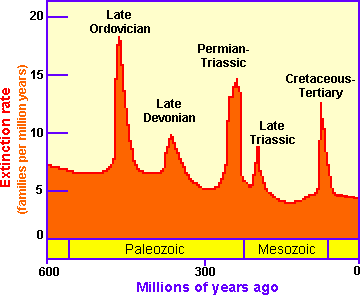 A graph of major invertebrate extinctions over the last 600 million years. The mass extinctions appear as periodic peaks rising above the background extinction levels. This data is from the work of D. M. Raup and J. J. Sepkoski. There have been many more minor extinctions.
The five largest mass extinctions in Earth's history occurred during:
- The late Ordovician period (about 438 million years ago) - 100 families extinct - more than half of the bryozoan and brachiopod species extinct.
- The late Devonian (about 360 mya) - 30% of animal families extinct.
- At the end of the Permian period (about 248 mya) - Trilobites go extinct. 50% of all animal families, 95% of all marine species, and many trees die out.
- The late Triassic (208 mya) - 35% of all animal families die out. Most early dinosaur families went extinct, and most synapsids died out (except for the mammals).
- At the Cretaceous-Tertiary (K-T) boundary (about 65 mya) - about half of all life forms died out, including the dinosaurs
 , pterosaurs, plesiosaurs, mosasaurs, ammonites, many families of fishes, clams, snails, sponges, sea urchins and many others.
Q:Will you give me information about the Corythosaurus dinosaur?
from Jacob D., Dumas, TX, USA; Jan. 5, 1998
A: Corythosaurus (meaning "helmet lizard") was a duck-billed dinosaur from the late Cretaceous period (70-95 million years ago). It had a helmet-like crest on its narrow head. This crest may have been used to make sound as it contained a system of tubes that went from the throat to to the nose. It walked on two legs and was a plant eater. It was about 30 feet (9 m) long and weighed about 2-3 tons. Fossils have been found in western North America, including a nearly complete skeleton from Alberta Canada.
Return to the top of the page.
Go to questions from 1997.
Enchanted Learning®
Over 35,000 Web Pages
Sample Pages for Prospective Subscribers, or click below
Click to read our Privacy Policy
Enchanted Learning Search
|
Search the Enchanted Learning website for:
|
Advertisement.
Advertisement.
Copyright ©1997-8 Enchanted Learning Software

