




 The first incandescent electric light was made in 1800 by Humphry Davy, an English scientist. He experimented with electricity and invented an electric battery. When he connected wires to his battery and a piece of carbon, the carbon glowed, producing light. This is called an electric arc.
Much later, in 1860, the English physicist Sir Joseph Wilson Swan (1828-1914) was determined to devise a practical, long-lasting electric light. He found that a carbon paper filament worked well, but burned up quickly. In 1878, he demonstrated his new electric lamps in Newcastle, England.
 The inventor Thomas Alva Edison (in the USA) experimented with thousands of different filaments to find just the right materials to glow well and be long-lasting. In 1879, Edison discovered that a carbon filament in an oxygen-free bulb glowed but did not burn up for 40 hours. Edison eventually produced a bulb that could glow for over 1500 hours.
Lewis Howard Latimer (1848-1928) improved the light bulb by inventing a carbon filament (patented in 1881); Latimer was a member of Edison’s research team, which was called “Edison’s Pioneers.” In 1882, Latimer developed and patented a method of manufacturing his carbon filaments.
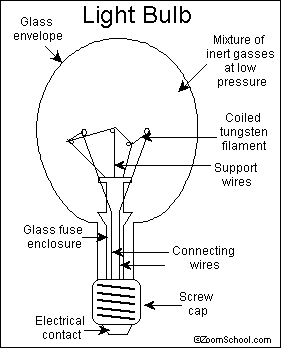
In 1903, Willis R. Whitney invented a treatment for the filament so that it wouldn’t darken the inside of the bulb as it glowed. In 1910, William David Coolidge (1873-1975) invented a tungsten filament which lasted even longer than the older filaments. The incandescent bulb revolutionized the world.